
Below is an excerpt of Palestine 1492: A Report Back, by Linda Quiquivix
There is a saying in English for when you’re speaking about someone who isn’t there and they suddenly appear: “Speak of the Devil.” This phrase is shortened from the longer “Speak of the Devil and he shall appear.” That second part is usually left out, as if too much has already been spoken.
In Spanish, the phrase is, “Speaking of the King of Rome, he’ll appear by the door.” Hablando del Rey de Roma por la puerta asoma. I can’t help but to interpret this to mean that across worlds it was previously agreed that the King of Rome was the Devil, or that the Devil was the King of Rome.
In Palestine, depending on who you ask, the Devil’s origins were far humbler than that. According to tradition, before he became known as the cosmic enemy of God, a figure called “the satan” appears in the Bible as God’s obedient servant whose job it is to check in on people unannounced, making them pass cruel tests to confirm their devotion to God.
When the Jewish people of Jesus of Nazareth organized their rebellion against the Roman Empire two thousand years ago, they were neither the first nor the last to adopt a good vs evil binary dualism to guide their struggle.[1] They say Christianity borrowed the binary from Manicheanism in Persia some centuries back, but still Christianity is credited with inventing the Devil in Palestine. I wonder: is this Christianity’s main difference from Judaism? That Judaism interprets God as doer of both good and evil, and in Christianity God is only doer of good and the Devil is doer of evil?
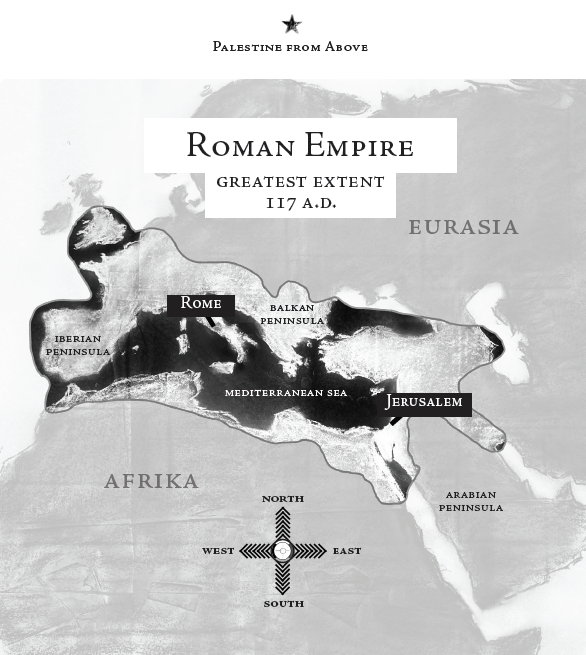
Speaking of the Devil, he has appeared. He is on the map above this paragraph. They say the Roman Empire reached its greatest territorial extent in the year 117 A.D. This is another way of saying the Roman Empire went into decline the day after. This was almost one hundred years after Rome assassinated Palestine’s rebel Jesus. As the map shows, the Devil used to surround all the Mediterranean Sea and its adjacent lands, including North Afrika, the Iberian Peninsula, and the Balkan Peninsula, all the way to Jerusalem.
It would still be two hundred years before the Devil would be baptized as Christian, his second-greatest trick, crucial for his first. By then the Roman Emperor almost had no choice but to co-opt the resistance. The word of the rebel Jesus was spreading widely along the Mediterranean’s peninsulas and ports all the way from Jerusalem.
Rome’s capture of Christianity granted it legitimacy to determine who was the Devil now, and it wasn’t going to be the King of Rome. Not in official History. The Emperor could now label his enemies the Devil to deflect attention from himself: Black Afrikans, Indigenous peoples, women, Jews, Muslims, pagans, other Christians against the empire were called the Devil by Rome, a baptism that transformed Christianity from a religion of the earth into a religion of the empire.[2]
There still exist today many Christianities from below, both from before and from after. But the health of their resistances to the capture has been weak.
Christianity has not been the only world captured. The Kingdom of Israel captured Judaism in the past and the State of Israel has captured Judaism again in the present.[3] Caliphs, kings, sultans, and ayatollahs have captured Islam in the past and continue holding Islam captive in the present.
Christianity’s capture has an official date and event: 312 A.D., the day Roman Emperor Constantine was baptized in the city he would soon name after himself, Constantinople.
The acronym A.D. in all this means anno Domini nostri Jesu Christi, meaning after the birth of “the Year of our Lord Jesus Christ”. This notation is used today by a global empire that calls itself “secular,” meaning not religious. Secular is a word that helps the Devil pull off his greatest trick, getting everyone to believe he does not exist where he actually exists.
For the years before the birth of Christ, the traditional notation is Before Christ (B.C.). Its secularized notation is Before Common Era (B.C.E.), and A.D. is secularized as C.E. (Common Era). Not everybody uses the secularized notation. There is no secularizing that the birth of Christ remains the empire’s Year Zero. That’s not every world’s Year Zero.
In the Jewish calendar, Year Zero is “From the Creation of the World” according to Jewish tradition, almost 4,000 years before Europe’s Year Zero. Islam’s Year Zero comes 622 years after Europe’s, that is, 622 A.D., the year of the hijrah, the journey the prophet Muhammad and his followers took from Mecca to Medina. Year Zero for the Maya is the domestication of maize in one of the calendars, while events millions of years from before and after are counted in the other Maya calendars.
Empires, secular or not, regularly capture the resistance from below to co-opt it, to neutralize it. Too often they succeed; death and destruction are not easy to resist. Neither are the Devil’s seductions.
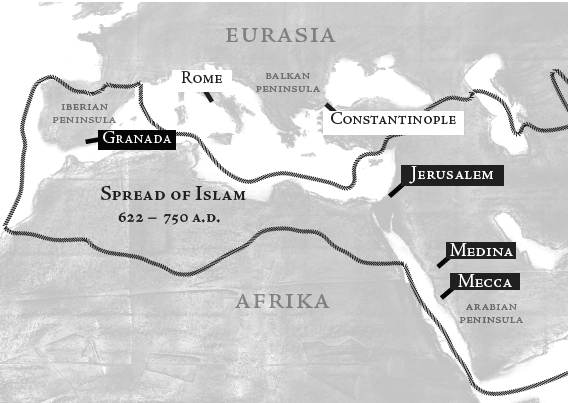
Three hundred years after Christianity’s capture, Islam would be born in the Arabian Peninsula, spreading quickly up to Jerusalem and throughout Rome’s territories. Understandably, this upset the Roman Empire, less because it was Christian, more because it was an empire, one challenged by other empires similarly familiar with the power of capture.
Notice Granada on the map.
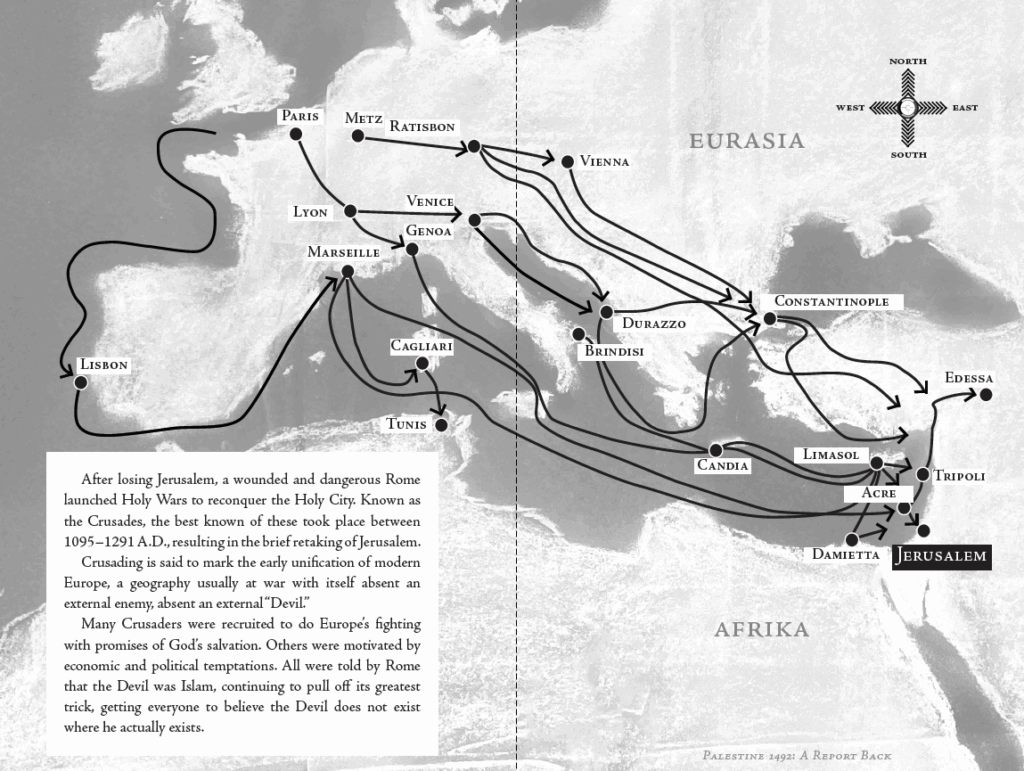
After losing Jerusalem, a wounded and dangerous Rome launched Holy Wars to reconquer the Holy City. Known as the Crusades, the best known of these took place between 1095–1291 A.D., resulting in the brief retaking of Jerusalem.
Crusading is said to mark the early unification of modern Europe, a geography usually at war with itself absent an external enemy, absent an external “Devil.”
Many Crusaders were recruited to do Europe’s fighting with promises of God’s salvation. Others were motivated by economic and political temptations. All were told by Rome that the Devil was Islam, continuing to pull off its greatest trick, getting everyone to believe the Devil does not exist where he actually exists.
This has been an excerpt of Palestine 1492: A Report Back, by Linda Quiquivix
Footnotes
[1] Richard A. Horsley, Jesus and Empire: The Kingdom of God and the New World (Fortress Press, 2002); and Neil Forsyth, The Old Enemy: Satan and the Combat Myth (Princeton University Press, 1989)
[2] Wes Howard-Brook, Empire Baptized: How the Church Embraced What Jesus Rejected (Orbis Books, 2016)
[3] Marc H. Ellis, Beyond Innocence and Redemption: Confronting the Holocaust and Israeli Power: Creating a Moral Future for the Jewish People (Harper Collins, 1991)