This is an excerpt of Palestine 1492: A Report Back, by Linda Quiquivix
I begin this chapter by clarifying right away that there exists a Europe that isn’t an asshole. I met that land briefly some years back. It has a different name though, Slumil K’ajxemk’op in Mayan-Tzotzil, meaning Tierra Insumisa in Spanish, Rebellious Land in English.[1]
This chapter is not about Slumil K’ajxemk’op, those lands from below in the struggle for life. This chapter is about the Europe from above, a wounded and dangerous Europe of great physical, spiritual, emotional, and mental imbalance.
Not everyone who sees Europe as extremely dangerous also sees it as wounded. But we can hear the wound if we know where to listen. When Europe talks about its calendar, for example, it describes what happened before its year 1492 A.D. as “dark.” For centuries, it was “the Dark Ages,” Europe says about a time when it was wasn’t an empire anymore, a time it doesn’t like to talk about. The rest of the earth, Europe alleges, was also in the Dark Ages, capitalizing it like that to declare it official. It was only after 1492 A.D. when Europe says it found Enlightenment, also capitalized.
We can also locate Europe’s wound if we learn to listen to how Europe speaks in everyday life. It often talks about light and dark in binaries of light vs dark, not in fluid dualities of light and dark. It maps this a binary onto a morality of good vs evil, which it translates as Europe = always good, non-Europe = always evil. Binaries have a hard time allowing any fluidity between opposites. It’s like Europe is stuck.
We can feel Europe’s wound if we pay attention to how we feel when we try to be next to Europe. It feels as if on reflex Europe always wants to fight, a type of paranoia that the stranger is an enemy rather than the stranger is a mystery. Wounded Europe’s basic relation tends to be war with only two options: kill or be killed, eat or be eaten, rise above or be crushed below. Europe’s war forces lightness and darkness into a cosmic imbalance where lightness is always good and darkness is always evil, not mattering to Europe that’s not how the cosmos work. But you learn pretty fast when you encounter Wounded Europe that it maps this binary war onto almost everything, even onto colors, even human skin color. That’s how fast you learn when you encounter Europe, or when Europe encounters you.
That time when Europe wasn’t an empire that it doesn’t like to talk about signals a wound. You can tell because when you bring it up, Europe always interrupts, preferring to jump back further in time to when Europe says it was Great, to when Europe says it was the Roman Empire, whose geography back then extended much farther than what is today known as the Continent of Europe, capitalized like that so you won’t look it up and learn Europe isn’t even a continent.
That Europe claims to be a separate continent is a fact of great confusion for those who value accuracy and consistency, for there exists no separate landmass called Europe. Which body of water separates Europe from Asia on that great landmass called Eurasia, nobody has been able to convincingly show. On the map below, Europe exists on the western edge of the large continent called Eurasia and directly north of Afrika, another continent.
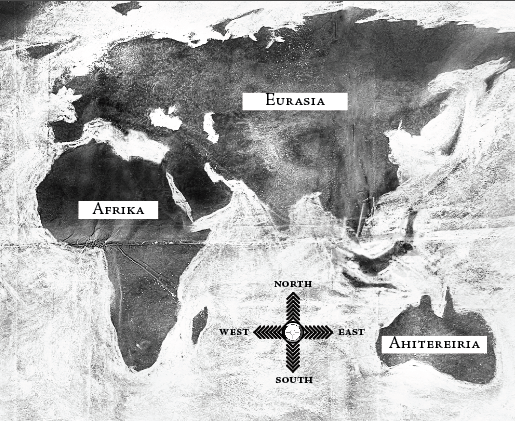
A third continent appearing on this map is Ahitereiria, an Indigenous name for the lands that have been called Australia by the Europeans since that land’s misfortune of having been found out by the Europeans.
For Ahitereiria it happened in 1606 by the world’s first corporation, the Dutch East India Company, a formation that allowed regular rich Europeans to collectively finance and profit from colonialism without having to appeal to the monarchs for resources or permission. Just like today.
That time when Europe says it was weak spanned over one-thousand-and-one years, but Wounded Europe smothers it in between its beginning, which it calls Antiquity, and its end, which it calls Modernity, eras it understands as Great and Great Again, respectively. The time in between, Europe calls the Middle Ages when it’s not calling it the Dark Ages, which it doesn’t like to talk about. Its calendrical arc thus goes from Great to Weak and back to Great Again. There is no more calendar after that.
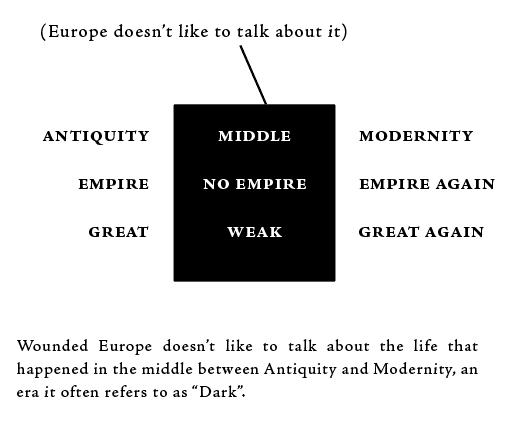
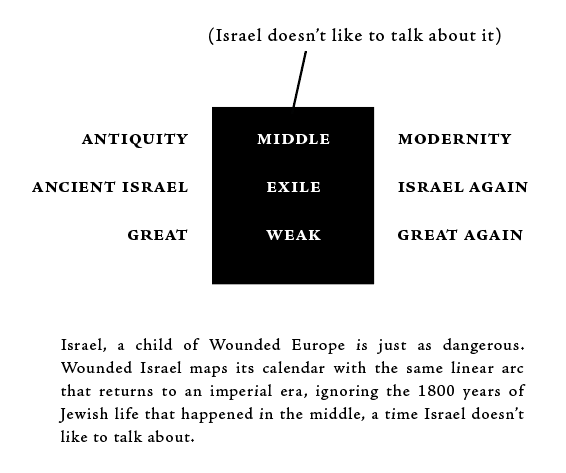
The absolute End of Time is central to Europe’s calendar, an era with astonishing finality that it calls the End Times or the End of History, depending. Maybe Europe’s obsession with the End is rational if you listen to how it describes itself: a world filled with “continual fear and danger of violent death, and the life of man, solitary, poor, nasty, brutish, and short.”[2]
Wounded Europe has a hard time thinking in allegories and metaphor about the end of the world. It speaks about ending it all literally, meaning the end of life on Planet Earth, meaning extinction, which is why it’s not mad at the current extinction, it is part of the plan. Wounded Europe fully expects to be rescued from a dying Earth in a literal sense. It is right now working on the spaceships.
Europe’s precise End Times calendar is accompanied by a geography of equally astonishing certainty: Jerusalem.
Christendom’s loss of Jerusalem to the Islamic empires appears to have slipped Europe into its Dark Age, and its obsession with Jerusalem appears only to have gained strength during this time. Europe’s world maps used to place Jerusalem not just anywhere on the map but at the center of the world.
The Bünting Cloverleaf Map was published in 1581 by a Protestant pastor of the so-called Holy Roman Empire. The map placed Jerusalem in the center of the world surrounded by Europe, Asia, and Afrika, following the world geography that believes Europe is its own continent.
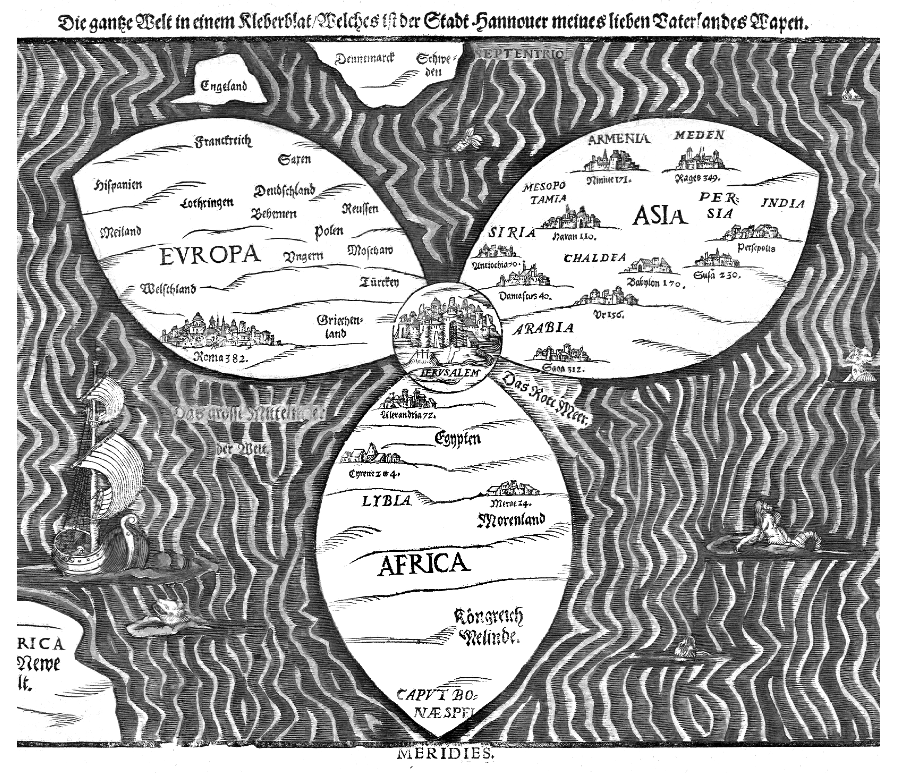
This map was published almost one hundred years after 1492. The existence of Abya Yala, a very other continent, was still a recent disruption to this Biblical world geography. Thus, rather than appearing as another clover leaf among the other continents, Abya Yala appeared as an out-of-place a blob in the bottom left corner labeled “America.”
On the opposite page is an example of Europe’s earlier world maps during its Dark Ages, known as T and O maps. The known landmasses on these maps were surrounded in a circle O of ocean, and a T in the center separating Asia, Afrika, and Europe. Notice how Europe depicted itself as a continent equal in size to Afrika and placed itself directly as Afrika’s opposite. Also notice the top of the map is oriented with east at top toward Asia, the direction of the Garden of Eden, the beginning of the Christian creation story.
Europe’s creation story tells that Europeans are the direct descendants of Noah, the Flood hero of the Hebrew Bible. Noah is said to have had three sons: Sem, Iafeth, and Cham, and each was sent to populate the world after the Flood: Sem to Asia, Iafeth to Europe, Cham to Africa. According to Wounded Europe, Noah cursed Cham and his descendants in Africa with Darkness and blessed Iafeth and his descendants with Lightness.
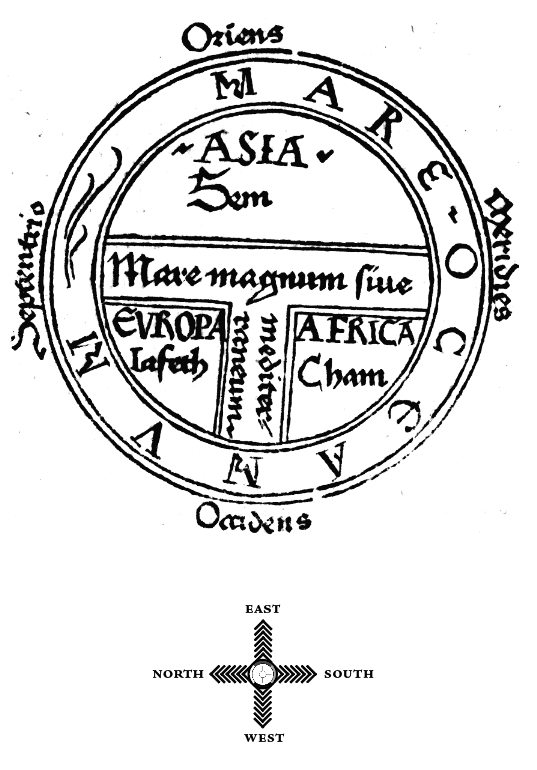
This map was published in 625 A.D., but originally did not have the labels shown here for Noah’s sons: Sem in Asia, Iafeth in Europe, and Cham in Africa. Those labels would be added by Europeans during the wave of race science in the nineteenth century, when they deployed science to prove their racism and anti-Blackness as a directive from God.
According to this map, Jews are descendants of Sem not of Iafeth and should be living in Asia not in Europe. This map helped me better understand the label Europe created for the Jewish people: Semites and the label Europe created for itself: anti-Semite.
Today, Wounded Europe’s world maps place Europe at the top of the map and as the center of the world.
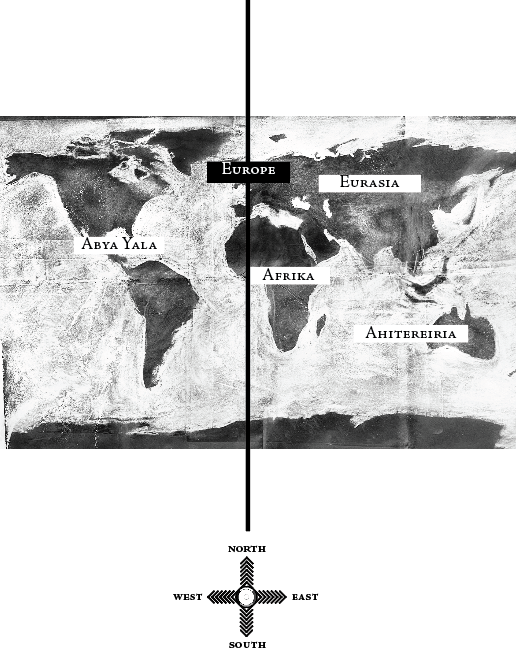
And not content with placing itself at the center of Space, Europe also places itself at the center of Time. The vertical black line on the map goes right through the Royal Observatory in Greenwich, London, a place that marks London’s midnight hour as the beginning of the day for the rest of the globe.
Although world maps today place Europe at the center of the world instead of Jerusalem, Europe still behaves like Jerusalem is at the center of the world, no matter how non-religious or “secular” Europe pretends to be.
Europe still expects everyone to call Europe “The West” even when Europe is not to everybody’s west, and expects everyone to call Asia “The East” even when Asia is not to everybody’s east. Europe’s world remains a geography still centered on Jerusalem.
In 1453 A.D., the Ottoman Empire captured Constantinople, marking the final death of the Roman Empire until its rebirth later that century by another name.
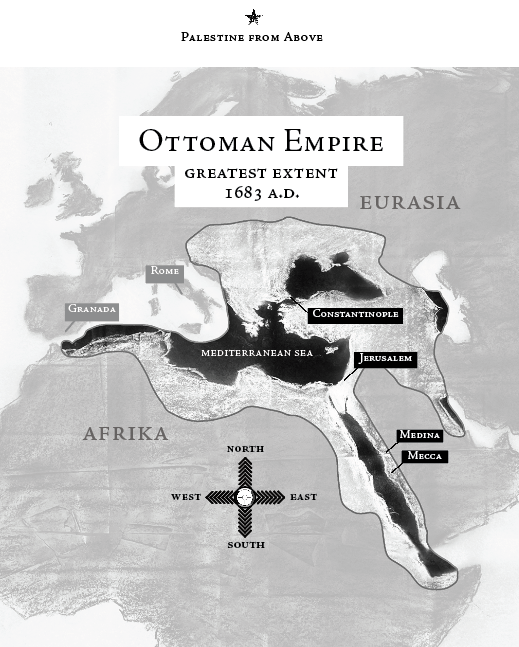
Constantinople, the City of Constantine, had been the seat of the Eastern Roman Empire, holding on much longer than the ancient Western Roman Empire had held on, which some historians argue had fallen almost one thousand years before in the year 476 A.D., an event many mark as the West’s transition from Antiquity to the Middle Ages.
Historians today debate whether the capture of Constantinople by the Ottoman Empire in 1453 marked the birth of Modern Europe, or whether Modern Europe was birthed later that century in 1492.
When time is more of a spiral than it is a line, everything is at once future, present, and past. Still, dates can be helpful bookmarks, and maybe it’s more helpful to mark 1453 as a year of death and 1492 as a year of resurrection.
Because they say the Devil also knows about resurrection.
This has been an excerpt of Palestine 1492: A Report Back, by Linda Quiquivix
Footnotes
[1] See Asking Questions with the Zapatistas: Reflections from Greece on Our Civilizational Impasse, by Theodoros Karyotis, Ioanna-Maria Maravelidi & Yavor Tarinskicover (Transnational Institute of Social Ecology, 2022); and “Building alliances in pandemic times: the Zapatista journey through Europe” by R. Aída Hernández Castillo in Debates Indígenas (August 1, 2021)
[2] Thomas Hobbes, Leviathan (1651)