Below is an excerpt of Palestine 1492: A Report Back, by Linda Quiquivix
It has been more than 500 years since Columbus and them first arrived in the Caribbean, or as the elders say, since Columbus and the other cannibals first arrived in the Caribbean spreading the wétiko virus, the contagious disease of selfishness.[1] It has been more than 500 years of struggles and still today, worlds exist in their ways from before and in their ways from after, ways that teach the You are my other me and I am your other you of the Maya peoples and the I am because we are of the Bantu peoples. More than 500 years of death and destruction, and worlds Indigenous to these lands are still in resistance, and not everyone has put down their weapons. The Zapatista Army for National Liberation (EZLN) in Chiapas is an important example of all these facts.
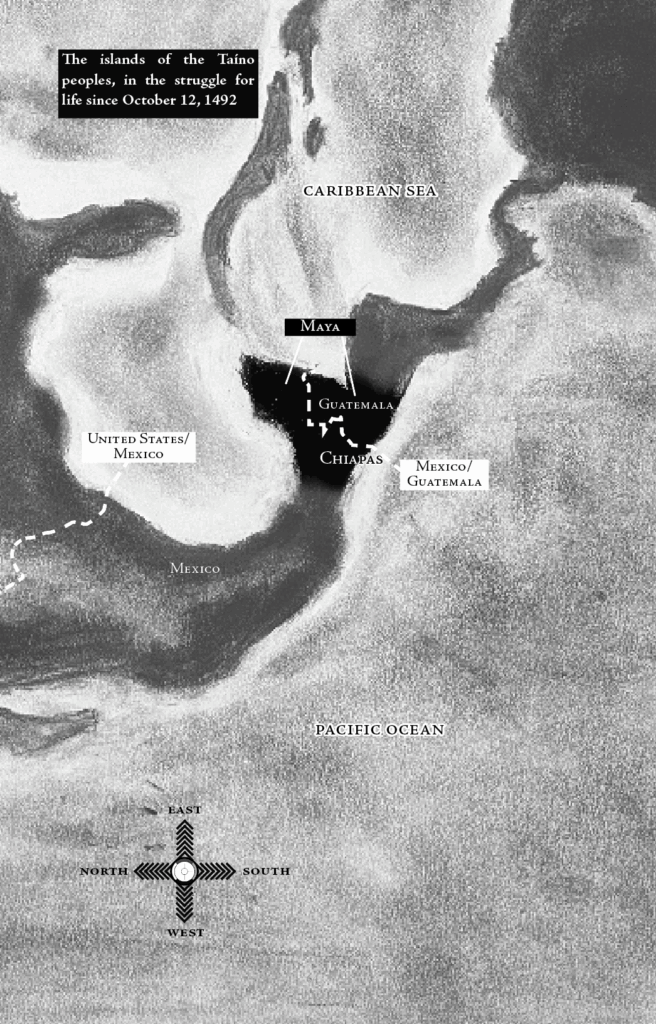
The Zapatistas are a Maya rebel movement in Chiapas, a geography directly north of the border between the State of Mexico and the State of Guatemala. Chiapas has existed far longer than either the State of Mexico or the State of Guatemala and is part of the larger Maya world still called by its many names, including Iximulew, where ixim means “maize” and ulew means “land.” (esheem-oo-le-oh)
I often mention Chiapas whenever I mention Palestine, and I often mention Palestine whenever I mention Chiapas. I encountered the two resistances at around the same time when I was first learning about the global struggles from below and against capital; when I was first learning to listen to the pains and the dignity of the below. There are many similarities between the two; there are many differences. Pains and dignity are constants in both. I prefer to die on my feet than to live on my knees, the Zapatistas are famous for saying. Like trees, we die standing, the Palestinians are famous for saying. Dying in order to live is a famous saying for both Palestinians and Zapatistas.
Palestinian compas say they don’t get to hear too much about the Zapatistas and have asked me to say more about them in this report back. I offer my interpretation of the Zapatistas here in the hope readers will listen directly to them rather than to me. The Zapatistas speak for themselves.[2] Parts of my offering might be more helpfully understood as witness testimony from someone raised by the world of Columbus and Them who can testify that world teaches Palestinians have never existed and that the Maya no longer exist. I can testify that worlds obsessed with “greatness,” the very definition of fascism, over-represent the stories of themselves as the stories of all humanity, as if empires, dynasties, kingdoms have ever been our only possibilities.[3]
Thus, when Columbus’ world speaks about Palestine, it speaks only of the empires, dynasties, kingdoms that have occupied Palestine. All of this stuff is not Palestinian history, Jihad had said. It’s the occupiers’ history. We have been occupied by Israel, then the Romans, then the Greeks, then the Turks, then the British, and then Israel. That is, by the United Kingdom of Israel, then by the Roman Empire, then the Byzantine Empire, then the Ottoman Empire, then the British Empire, and then the State of Israel on behalf of empire.
For those worlds obsessed with concentrating power as empires do, all relations fall into the logic of the chessboard: the logic of war. Kingdoms vs kingdoms, empires vs empires, states vs states, corporations vs corporations, families vs families, self vs self. Eat or be eaten. Everyone else is ultimately a pawn whether Pawn is their name or they’re called another name for disposable.
For worlds like that, where life is a zero-sum game, there is no possibility of peace, of Them and Us together, only of Them or Us. You’re either at the table, or you’re on the menu, the world of the cannibals likes to say. The small are useful only as discards at the service of the biggest cannibal of all, the master, emperor, dynast, king. It is a world infected by the wétiko disease.
Thus, when Columbus’ world speaks about the Maya, it also emphasizes the big: the large city-states, the tallest pyramids and temples, the doings of the rulers and its tax collectors, the size of its armies, the control of trade routes, the comings and goings of the elite. The above writes the history of the above and declares it official; it tends not to listen to the pains and dignity of the below. For the above, the below is wholly unimportant and absolutely necessary at the same time, for structurally there can be no above without a below. There can be no table if there is no menu. And nobody wants to be on the menu.
Anyone at the table can become part of the menu; anyone above can fall down below, the predator’s greatest fear, becoming the prey. Those above fight hard to maintain their seat and plate. There’s not enough pie, you often hear them say.
How do we live without becoming the same monsters as Them? When fewer of us can imagine another world is possible and we ourselves struggle for a piece of the pie, we need to know the wétiko has advanced.
Anyone at the table can become part of the menu; anyone above can fall down below, the predator’s greatest fear, becoming the prey. Those above fight hard to maintain their seat and plate. There’s not enough pie, you often hear them say.
In a world where death is abundant and the options are a binary of you against me rather than You are my other me, rather than I am we, those being crushed feel they have no choice but to crush others on the way to survival, on the way to eat. Cannibalism appears to be the only option when the resistance is weak to the wétiko disease.
Those refusing the binary of predator or prey become the hunted. One cannot opt out without a plan for escape and self-defense. The ones who refuse must self-annihilate as cannibals, if that is what they are, and become somebody else, somebody new with other fugitives and maroons. To build a place where there exists no more above vs below, where there exists no more wétiko. But without land, how does one maroon in place?
There exist some up above who feel bad about injustice but don’t see their world as diseased. They seek to keep their privileges, appear to be well meaning, feel bad, and hope to share the table with some of the below, as long as they don’t disrupt the status quo. They train them from youth, hence their obsession with the category of Youth.[4] They often call themselves “progressive,” as if it were progress to create more cannibals today than there were cannibals yesterday.
When the below desires acceptance from the above, the resistance to the wétiko is weak. That’s when naked violence is not always necessary. The prey come to defend the predator’s world as desirable, mocking other worlds as strange or impossible. The ones who call themselves progressives are key to this advance. Rather than escaping their dog-eat-dog world, as they call it, they fight for diversity among the predator class. They don’t like it when you point out diverse cannibals are still cannibals.
When the below desires to become the above, when the prey seeks prestige by outperforming the mediocre predators, the wétiko has become most advanced. This has been helpfully diagnosed as advanced fascism by political prisoner, Black Panther, and ancestor George Jackson, presente, as the next chapter shows.[5]
Nobody wishes to be on a fascist’s menu. In war, how we choose to stay alive is the ethical-political question we have as our task. A most important question before us is, How do we bring ethics into war?[6] How do we not eat each other in order to stay live? How do we keep our resistance strong in the midst of contagion? How do we not become the monsters that we fight?
If warding off an illness is our task, we can learn from the healers. When we are unwell, the Maya healers ask about our mother’s life while we gestated in the womb. It is a lesson that the past is also next to us and ahead, not only behind. It is a lesson that time is more a spiral than it is a line, it is a lesson for us to ask about the gestation of worlds, to ask about Columbus and Them’s time in the womb.
The world of 1492 carries a deep trauma about happenings from the womb, about things that happened before Columbus. The collapse of its favorite ancestor is a deep womb trauma, the crumbling of the Roman Empire to rival empires and its loss of Jerusalem. A classic story of the above falling down below. The world of Columbus and Them refers to this time as its Dark Ages and doesn’t like it when you bring it up.
The world of Columbus is not the only world traumatized. But it is diseased and globally contagious and is everybody’s problem now.[7] More than a global problem, the world of Columbus and Them has become a planetary problem. Healers testify it takes a lot of energy to get wounded killers who believe there’s no way out to drop their weapons. And still we have to try because it has become everybody’s problem now.
Knowing this about the world of Columbus and Them helps explain why it laments a so-called “collapse” of Maya civilization, which it marks on its calendar as the time the big structures stopped being built. That is how the world of Columbus and Them marks collapse. That world is unable to imagine that the Maya are still here, at once from before and from after, and that the end of some worlds can sometimes be desirable and even deliberately engineered by those below.
Encountering the below requires attention to things that go erased by the dominant world, most important is attention to the fact that other worlds are still in existence. The Zapatistas say their struggle is for a world where many worlds fit, and by this they don’t mean a multi-polar world, they mean a world where all worlds can fit, where universalisms are inadequate, where not even a single universe is adequate.[8] A world that begins with We are equal because we are different, as the Zapatista women say, is a world where all worlds fit.[9]
Encountering the below requires attention to war, to its predations on life, to the extermination of the ones defending life. To walk with the Zapatistas is to see the reality that there are no honest solutions from empire against domination; empire is the domination. There are no honest solutions from capitalism against extinction; capitalism is the extinction. To walk with the Zapatistas is to see the reality of war and to learn to see it from where you live, too, if you hadn’t already been able to see it before.
In a context of planetary emergency, the Zapatista struggle is not only for the Maya worlds of Chiapas or the Indigenous worlds of Mexico. Theirs is a struggle for life, and life not just for some, life for all. Everything for everyone, nothing for ourselves, as they often say. Thus, to encounter Chiapas requires more than attention to war; it requires attention on how to fight a war so that there will be no more wars; how to have an army so that there will be no more armies. This enormous task requires reflecting on what it means to be human, the deep ancestral work the Maya-Tojolabal are known for living.[10]
We are an army, and an army is the most absurd thing there is because it is resorting to the force of a weapon to be right, and a human being who has to resort to a weapon to be right, is not a human being.”[11]
The EZLN is the military, self-defense arm of the Zapatista bases of support. Because it is a military, the EZLN’s formation is hierarchical. That the base is organized to exercise authority places the military at the service of the base, not the other way around.[12] The bases are diverse, composed of different Maya communities who speak distinct Mayan languages, including Tojolabal, Tzotzil, Tzeltal, Ch’ol, Zoque, and Mam. They organize in assemblies in order to build, maintain, and defend themselves from capital’s predations. In the land they took back in their 1994 uprising, they have built autonomous schools, clinics, economic cooperatives, banks, communications, media, and government. Power in Zapatista territory flows more dispersed than it does concentrated. Their structure of governing is more horizontal than it is vertical. Their territory is more of a web than it is a container. In terms of size, the Zapatistas are very small, and the Zapatistas are very big, depending. Their reach is local, national, global, and intergalactic, all at the same time.
…to encounter Chiapas requires more than attention to war; it requires attention on how to fight a war so that there will be no more wars; how to have an army so that there will be no more armies.
In the Zapatista Maya world, empire’s pyramid is turned upside down. That is, the base is the authority. Here, the people rule and the government obeys, the signs throughout Chiapas announce. Their governing structure rotates positions among the base themselves. Positions can be immediately revoked and replaced in case of corruption. The structure of government wards off corruption rather than incentivizes it. There are no politicians in Zapatista territory; there are no salaries. Governing is a community obligation not a career. It is a duty, a burden, a responsibility, and it is everybody’s right.
Zapatista governance is guided by a Maya-Tojolabal ethical-political commitment of mandar obedeciendo (“to lead by obeying”). To lead by obeying means the people rule and the government obeys. It means the people rule and the military obeys. To lead by obeying guides the flow of power within the community so that it circulates in an everyday dispersed fashion rather than concentrating on any single leader.[13] Its seven guiding principles are based on respectful power relations that must be followed by anyone in a leadership position, accountable to the assembly, obeying the assembly:
1. To obey, not command
2. To serve, not serve oneself
3. To represent, not supplant
4. To build, not destroy
5. To propose, not impose
6. To convince, not defeat
7. To go below, not go above
Many who walk with the Zapatistas believe their philosophy and practice of mandar obedeciendo to be their most important contribution to contemporary politics precisely because it is not a model to be replicated or a blueprint to be followed; it is a strategy to circulate power into harmonious balance. It is an offering, a proposal, a sharing, a lesson, an invitation to not only survive but to thrive, together and side by side.
Without a prescription for revolution, without doctrine to follow, the Zapatista communities encourage us all to struggle for life while caminando preguntando, while asking questions as we walk from where we live in our own geographies, in our own calendars, in our own ways.
It was on January 1st of 1994 when the world first heard the shouts of ¡ya basta! (enough!) of the EZLN in Chiapas. But by the time the world first saw the armed, Maya rebels liberating land in the mountains of the Mexican Southeast that New Year’s Day, a decade had already passed since the EZLN first began quietly organizing.[14]
While the EZLN first formed in 1983, as Maya communities the Zapatistas have been in resistance for much longer, something they made clear in their First Declaration of the Lacandón Jungle. Their famous first line, We are the product of 500 years of struggles, was amplified globally by journalists and sympathizers with access to the internet back when the internet was still small.[15]
The Zapatistas are sometimes called neo-Zapatistas, or “new” Zapatistas, for they take their name from ancestors from an earlier land-back struggle also in Mexico, launched 84 years before in 1910. These “old” Zapatistas were led by Emiliano Zapata who issued his declarations in Nahuatl, his native language. The Mexican Revolution as it became called, began as a demand for regime-change and ended as a struggle for land:
Notlac ximomanaca! Nehuatl onacoc; oncuan on ipc tepoztli ihuan nochantlaca niquinhuicatz. Ipampa in Totazin Diaz aihmo ticnequi yehuatl techixotiz. Ticnequi occe altpetl achi cuali. Ilhuan totlac ximomanaca ipampa amo nechpactia tlen telaxtlauhia. Amo conehui ica tlacualo ica netzotzomatiloz.Noihqui nincnequi nochtlacatl quipiaz ital: oncuan on quitocaz ihuan quipixcaz tlaoli, yetzintli ihuan occequi xinachtli. Tlen nanquitoa? Namehan totlac namomanazque?
Join me. I rose up. I rose up in arms and I bring my countrymen. We no longer wish that our Father Diaz watch over us. We want a much better president. Rise up with us because we don’t like what the rich men pay us. It is not enough for us to eat and dress ourselves. I also want everyone to have his piece of land so that he can plant and harvest maize, beans, and other crops. What do you say? Are you going to join us?[16]
In 1521, after Hernán Cortés and Them took Tenochtitlan, the capital of the Mexica Empire, pronounced “meh-SHEE-ka,” or as the anthropologists call it, Aztec, the conquistadores right away granted themselves their own slave plantations. They say the King of Spain had ordered Cortés not to. The Spanish Empire had recently entrusted its conquistadores in the Caribbean with a franchise of plantations called encomiendas. Becoming an encomendero, a soldier-turned-landowner of the Empire’s plantations, had been the reward for conquering the Taíno islands in the Caribbean on behalf of the king.
Guanahaní, a Taíno name for an island in the Bahamas meaning “Small Upper-Waters Land,” is said to be where Columbus and Them first landed on October 12, 1492 before sailing south and finding out about Cuba, from the Taíno word cubao, meaning “Where Fertile Land Is Abundant”. After Cuba, they found out about Ayiti to the east, today the island called Haiti, meaning “Land of High Mountains” in Taíno. By the time of Cortés and Them, only a couple decades later, the plantation franchise had nearly exterminated the Taíno communities across the islands.
They say the Spanish Empire had ordered Cortés not to do the same in Anahuac, in the “Lands Close to the Water,” the place today called Mexico. Empires aren’t known for having a problem with enslavement or extermination. This particular Empire was concerned with maintaining a steady labor force in its new gold mines and sugar-cane plantations. The Spanish Empire would soon resolve its labor problems by kidnapping and enslaving tens of millions of Afrikans, a human trafficking operation where the empires of the Portuguese, French, Dutch, and British also took part.
It would be three hundred years later, in 1804, when the enslaved Black Afrikans in the Ayiti plantation would rise up against their masters and declare their independence, also on a New Year’s Day. As a slave rebellion, the Haitian Revolution was uncommon. Historically, it has been competing masters who have declared independence against other masters. Those are the ones at the United Nations today.
Mexican Independence is an example. After his defeat of the Mexica Empire in 1521, Cortés soon became overseer on behalf of the Spanish Empire of a large plantation called the Viceroyalty of New Spain. Exactly three hundred years later, in 1821, the descendants of Cortés and Them would declare independence from their masters, taking dominion of the land and its people for themselves as the Spanish Empire had previously modeled. The above switched faces and names, but for the below, things remained the same.
During those prior three hundred years as the Viceroyalty of New Spain, not all native communities were enslaved. Many simply paid tribute to the Spanish Empire as they had previously paid tribute to the Mexica Empire. Many were able to maintain their traditions and communal lands, the calpullalli, the Indigenous land-tenure system where land-use rights belong to a community as a whole, and the rights and responsibilities to farm the land are granted to the families of that community, similar to the musha’ in Palestine and neighboring lands. With the common lands preserved, communities outside the plantation system’s reach could still grow their milpa, their traditional maize field of shifting cultivation where the beans spiral up the maize stalk while feeding the soil, and where the squash spreads widely below while shading the ground. Maintaining a milpa makes it so one does not have to eat other humans to survive. By contrast, the native communities subjected to plantation labor by Cortés and Them had been forced to grown sugar cane for colonial extraction.
After the Mexican ruling class achieved independence from Spain in 1821, that is, after the creation of the United Mexican States, or “Mexico,” the descendants of Cortés and Them would divide the communal lands, the calpullalli, into plots of private, individual ownership. This scheme was made constitutional law in 1857, the height of what Mexican historians call the country’s “liberal reforms.” This was happening in Palestine at about the same time of the Ottoman Empire’s modernization reforms, the Tanzimat.
The Mexican Revolution would explode fifty years later in 1910 against these reforms and has become described as a struggle against “liberalism,” a political philosophy out of Europe that emphasizes individual rights over communal rights. Liberalism shares with other European philosophies the treatment of land as an object of property, profit, and control, deploying a diversity of tactics, using the cover of law and the threat of violence, rather than always resorting to naked violence.[17]
The Mexican Revolution’s Emiliano Zapata would become a beloved ancestor for fighting for land back until his death, dying while standing, dying for refusing to sit on the throne when he was offered it. Zapata would share the fate of others who have similarly refused the disease.[18] Unable to be bought, Zapata would be killed in an ambush by the Mexican ruling class, by the Mexico from above. His assassins would continue to rule over Mexico by co-opting the Revolution and Zapata’s image, interpreting the problem of liberalism to mean the problem of foreigners treating land as an object of property, profit, and control; the “nation” was allowed to do with the land between its borders as it wished, extracting, pillaging, destroying it as the so-called “Mexican nation” wished.
This Mexican nation had been designed from the perspective of the descendants of Cortés and Them who added a Mexica aesthetic to designate Mexico as special and unique from the Spanish Empire. Spain’s racist categories of blood purity remained. The Mexican nation was designed as mestizo, meaning culturally European with Indigenous and Black Afrikan ancestry, but not a lot of discussion about the Indigenous and Black Afrikan ancestry beyond the music, the “Aztec” Empire, and the food. Always the food.
The Mexicanization campaign post-Revolution attempted to impose on everyone the ruling class’s conception of Mexico: one language, one religion, one history, one culture, one way. The colonial relation still remained: the above vs the below. The destruction of the Indigenous peoples was successful by some measures. In two generations, most Mexicans would no longer speak their native language and wouldn’t even know they were Indigenous. New Zapatistas had to emerge to remind them.
The EZLN uprising in 1994 reminded the world of the Mexico profundo, the Mexico from below, of the worlds that Columbus and Them for 500 years have tried to erase.[19] The neo-Zapatista uprising had at first been aimed only at the political party of the ruling class: the Institutional Revolutionary Party (PRI). The PRI had long ago co-opted the Revolution in name and brutally clung to power by any means necessary, famously opening fire on university students in protest in a Mexico City borough called Tlatelolco, meaning “In the Little Hill of Land” in Nahuatl. Even after massacring 25 people on October 2, 1968, Mexico City hosted the Olympics on October 12th to celebrate the Mexico of Columbus and Them. Ruling through fear of further massacres, Mexico’s PRI would hold uninterrupted government power for most of the twentieth century. New Zapatistas had to emerge to pull off the mask.
Before his assassination in 1919, Emiliano Zapata had lived to witness the drafting of a new constitution that included a form of land back: the ejido, a state-protected category of communal lands inspired by the calpullalli. With the new protections, landless communities had been granted the land they required through the ejido, even if it meant expropriating the large private holdings. Private plots could still operate, and their ownership title transferred freely, but the ejido was protected from theft, sale, and real-estate speculation. The land now belonged to “the nation,” as Article 27 of the Mexican Constitution of 1917 put it during Zapata’s time,
The lands, waters, and natural resources understood to be within the borders of national territory, belong to the nation, whether they be above or below the land. The nation regulates the management of these lands and resources.
But what the ruling class is allowed to grant, the ruling class is allowed to take away. Decades later in 1992, the PRI removed the ejido from constitutional protection, doing away with the Mexican Revolution’s greatest legacy. The constitutional revision paved the way for mass transfer of rural land from Indigenous communities to transnational corporations through both legal means and illegal means. The lands fought for by the older Zapatistas earlier that century were now an object of property, profit, and control again, a liberalism again, a new liberalism, a neo-liberalism.
The ejido’s destruction had been made a prerequisite for Mexico’s entry into the North American Free Trade Agreement (NAFTA) of 1994, a treaty between Mexico, the United States, and Canada that allowed for the free-flow of capital and commodities while hindering the free-flow of people who NAFTA promised to displace. Factories in the United States and Canada shut down and moved to Mexico, where the government ensured labor was cheaper and environmental restrictions almost non-existent. At the same time, the common lands could now be bought and sold and controlled by transnational corporations.
Thirty years after NAFTA, which now goes by USMCA, the United States–Mexico–Canada Agreement, the destruction of the ejido has led to an emptying of Indigenous peoples from the land for profit at a scale Cortés maybe only dreamed of. Thirty years on, tens of millions are caught in a wandering nightmare of displacement through legal means: they mortgage the land to a bank for credit and are unable to pay back the loan. It is also displacement through illegal means, refusing to sign with mining corporations, kicked off the land through a narco-terror response the politicians pretend to have nothing to do with.[20] A wandering nightmare of displacement through legal means and illegal means, whichever one can be most efficient for capital, whichever one is most pragmatic.
The wandering nightmare of displacement in a foreign place to sell your labor, which you didn’t have to sell so much of before and hopefully someone will buy because now there is no land, and now you need money for food, for shelter, for water, for air, for fire, for your children, for your community, for everything, and not many are buying your labor in your country, so you need to see if you can get to El Norte, to The North, and see if you can cross the border and make it to the other side while trying not to get caught and while trying to keep alive.
Thirty years after NAFTA, for the Mexico from below the border has become a graveyard in those places where it’s not already a wall. For the Mexico from above, a stark contrast: a place at the table alongside global elites, where today nationalities are less important than one’s bank account. NAFTA ushered in the ability for a Mexican capitalist of Lebanese descent to only six years later be ranked the world’s richest person, the world’s biggest cannibal of them all.
The EZLN rose up on the day NAFTA went into effect on January 1, 1994, hoping the rest of Mexico would join them in Mexico City to overthrow the PRI. Their demands were housing, land, work, food, health, education, justice, independence, liberty, democracy, and peace. Instead of joining the rebellion, the Mexican nation called for a ceasefire, seeking to prevent a bloody war like the one in Guatemala next door and Colombia further south next door. The EZLN listened and declared a unilateral ceasefire after 12 days, deploying their word as their weapon to stay in the fight.[21] Six months later, they issued a Second Declaration.
While in the First Declaration, the EZLN had called upon the Mexican people to take up arms against who they saw as the main obstacle to democracy in their country: the Party-State, in the Second Declaration, they called the Mexican people to a civic and peaceful effort through a national democratic convention, an effort that was met by the PRI and its supporters with lies, fraud, mockery, and assassinations.
Six months later, on the first anniversary of their uprising, the EZLN issued a Third Declaration where they called on “all honest Mexicans” to form a national liberation movement, install a transitional government, create a new constitution, and destroy the system of the Party-State.
A year later in the Fourth Declaration, issued on the uprising’s second anniversary, they announced the creation of five peaceful resistance centers in Zapatista territory as gathering points for Mexican culture and cultures of the world. And they announced they would continue with government peace talks, the San Andres Accords, about the rights and culture of Indigenous peoples for all of Mexico, not only Chiapas.
With the National Indigenous Congress (CNI), a network of Indigenous communities throughout Mexico co-founded by the Zapatistas, the Mexico from below drafted the San Andres Accords, which the Mexican government would sign but would not fulfill. Maybe some Zapatistas knew this would happen because they refused a handshake photograph. Maybe they had learned from a long line of deceptive “peace” treaties not to trust the oppressor’s definition of peace. Maybe they had seen what happened with Palestine and the Oslo Accords in September 1993, only four months before January 1, 1994, and learned not to photograph any handshakes.
After signing the San Andres Accords, the Mexican government sent military and paramilitary groups to infiltrate and attack the Zapatista communities and their supporters, even more than the cannibal government had done before. This exploded in a paramilitary massacre in December 1997 of 45 people praying in a church, all members of a pacifist group sympathetic to the Zapatistas. Acteal, presente.
In the Fifth Declaration, issued in July 1998, the Zapatistas convoked Indigenous communities across Mexico to mobilize with them to demand the San Andres Accords become national law. The process ended with every political party betraying the Accords by refusing to ratify them, including the progressive party of Andrés Manuel López Obrador, at the time the Party of the Democratic Revolution (PRD) and future “progressive” President of Mexico but not for many years yet.
They often call themselves “progressive,” as if it were progress to create more cannibals today than there were cannibals yesterday.
After this betrayal, the Zapatistas retreated into a silence. In 2005 they began issuing the Sixth Declaration, issued in sections throughout the following year. The Sixth Declaration announced the Zapatistas would no longer engage with political parties, politicians, bad governments, all of the above. Instead, they would struggle “from below and to the left.” The Sixth Declaration tells the story of the Zapatista struggle in their own words and illustrates how capitalism functions both globally and locally, and shares the beginnings of their political proposal for all the peoples of the world to struggle together, in their own calendars, their own geographies, their own ways.
Well before the Sixth Declaration, the movement had long been sharing its theories on global capital in a historical moment they call the Fourth World War, a war that began as soon as the Third World War ended, as soon as the badly named “Cold” War ended.[22] The Zapatistas theorize that since the expansion of global capital following the fall of the Soviet Union, capital has become the global sovereign and has subordinated the nation-state to an administrative function that works on its behalf. Capital’s predatory logic and practice means the enemy in this Fourth World War is not any one nation or any one state; it is anyone who gets in capital’s predatory way. It is a theory difficult to argue against when using reality as the judge. The Zapatistas say out loud what everybody sees but no one likes to talk about, that the ruling class are administrators of capital, its many overseers of a global plantation made up of other plantations, patriots to their wallets, not to any nation. In such a context, the Sixth Declaration emphasized that to continue doing the politics of the politicians would be a death sentence for Indigenous peoples, a death sentence for Mexico, a death sentence for the world. The Sixth Declaration was issuing warnings about it decades ago.
The Sixth was issued as López Obrador was making his first presidential run in the summer of 2006, running a campaign against the eventual winner, Felipe Calderon. In that election, the Zapatistas did not support any politician, including López Obrador. They had witnessed his role in the betrayal of the San Andres Accords. They did not tell anyone to vote for president; they did not tell anyone not to vote for president. Instead they launched the Other Campaign parallel to that year’s presidential campaigns, except traveling throughout Mexico listening to the pains of the below rather than asking for their vote.
For not supporting the progressive presidential candidate, the Zapatistas predicted they would be abandoned by the institutional left and its cannibalistic platforms of “progress”. Their predictions were correct. After the Sixth Declaration, the institutional left began calling the Zapatistas irrelevant, hardly in existence, even dead. Just like Columbus and Them.
That summer of 2006 it was widely recognized that Felipe Calderon had stolen the election from López Obrador. Soon after his inauguration, Calderon launched a War on Drugs, imitating the one in the United States. Like the one in the United States, Mexico’s War on Drugs is not against drugs but a war to manage each state’s surplus populations and a war against those who get in capital’s way. The United States tends to imprison its surplus population, as it considers people of Black Afrikan and Indigenous descent when it’s not letting them die through landlessness, poverty, illness, and disease. Mexico tends to kill or disappear its surplus, also people of Black Afrikan and Indigenous descent, also left to die through landlessness, poverty, illness, and disease.
In Mexico from 2006 to today, hundreds of thousands of lives have perished between the territorial disputes of drug cartels who buy the politicians and kill or disappear the ones they can’t buy. The post-Revolution Mexican nation has unraveled, and few dare to speak about it out loud.
In 2018, López Obrador would become president on his third try. Again the Zapatistas would not support him. Again the institutional left would slander the Zapatistas, calling them agents of empire while in willful ignorance that López Obrador’s presidential campaigns had all been financed by the Sinaloa drug cartel, something few have dared speak about out loud.[23]
To be fair, López Obrador and his followers have not been the only politicians on the narco payroll. The Sinaloa Cartel had previously financed all his rivals, including Calderon, who deployed the War on Drugs against Sinaloa’s rivals.
With the function of the nation-state now at the service of a global capital that runs legal and illegal, the narco-state of Mexico oversees a social fabric undone and plunged into fear. Landless people in cities are now dependent on capital to live. Many urban hopes are today placed on fascism, on strong men, politicians, drug lords, and politician-drug lords, anyone who will give handouts, food, a sense of security, even a false sense of security. Thirty years ago, the EZLN called upon the Mexican nation to join their uprising for land. The Mexican nation responded they did not want to spiral into bloody war, like Guatemala and Colombia next door. Mexico thirty years later has spiraled into a bloody war, on many occasions surpassing Guatemala and Colombia next door.
The Zapatistas often say that changing the world is difficult and even impossible, and so the world has to be created anew. Every presidential election every six years, the Zapatistas often find themselves alone in Mexico. Their very other calendar speaks not of six years but of seven generations. In the meantime, they continue building and defending their autonomy, always from below, weaving with those who can see them, speaking with those who can listen. Sometimes not speaking at all.
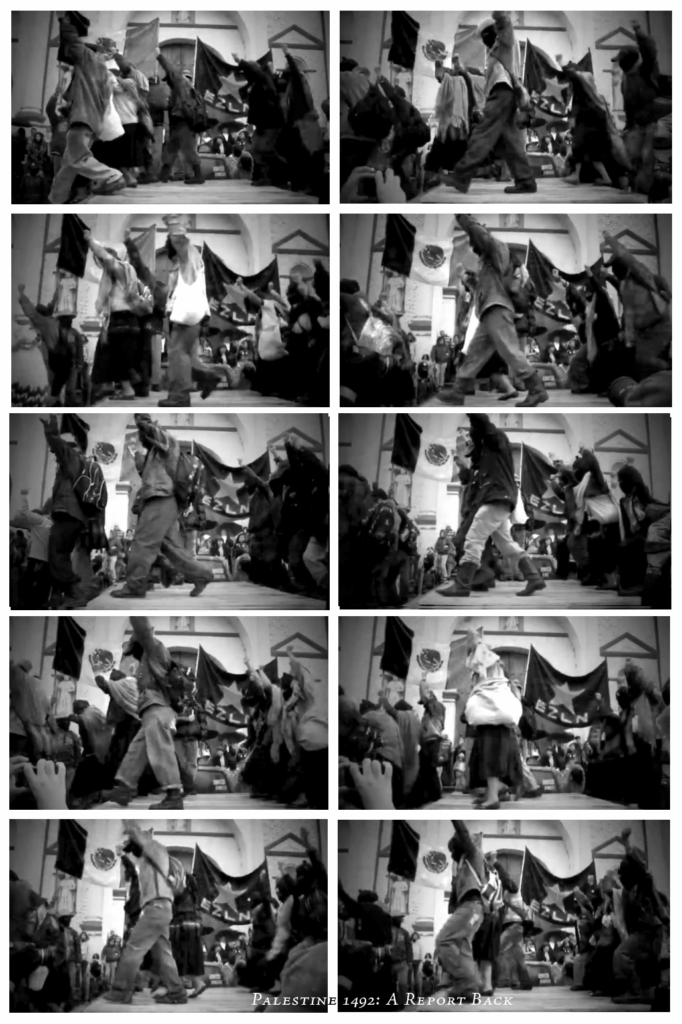
On December 21, 2012, as some interpreted the end of the Maya long count as an “end of the world” prophecy, more than 40,000 Zapatistas of all ages marched in silence throughout several cities in Chiapas that day. They erected a stage with a ramp on each side for all to ascend and descend, left fists up. Not a single word was said out loud.
Everything they had to say that day, they published in a brief communiqué:
Did you listen?
It is the sound of your world crumbling.
It is the sound of our world resurging.
The day that was day was night.
And night shall be the day that will be day. [24]
On December 21, 2012, while some interpreted a Maya prophecy for the end of the world, the Maya Zapatistas were promising the end of this world.[25] The end of this world for the creation of the world anew.
A new world for which if we must die, we die standing.
On our feet, not on our knees.
Dying standing like the trees.
This has been an excerpt of Palestine 1492: A Report Back, by Linda Quiquivix
Footnotes
[1] Jack D. Forbes (presente) Columbus and Other Cannibals: The Wétiko Disease of Exploitation, Imperialism, and Terrorism (Seven Stories Press, 1978)
[2] The Zapatistas regularly share their word in communiques that are published, translated, and archived at Enlace Zapatista:
https://enlacezapatista.ezln.org.mx
[3] For a survey of other possibilities, see The Dawn of Everything: A New History of Humanity, by David Graeber and David Wengrow (Allen Lane, 2021). David Graeber, presente
[4] Mayssoun Sukarieh and Stuart Tannock, Youth Rising? The Politics of Youth in the Global Economy (Routledge, 2014)
[5] George Jackson, Blood in My Eye (Random House, 1972)
[6] “Notes on Wars: Start of the Epistolary Exchange on Ethics and Politics” Subcomandante Insurgente Marcos and Luis Villoro (2011), reprinted in La Cuarta Guerra Mundial, The Fourth World War (Paliacate Press, 2024)
[7] Elizabeth Kolbert, The Sixth Extinction: An Unnatural History (Henry Holt and Company, 2014)
[8] See Pluriverse: A Post-Development Dictionary, edited by Ashish Kothari, Ariel Salleh, Arturo Escobar, Federico Demaria, and Alberto Acosta (Tulika Books, 2019)
[9] See “The Zapatista Women’s Revolutionary Law as it is lived today” by Sylvia Marcos in openDemocracy (July 2014)
[10] See Carlos Lenkersdorf’s Los hombres verdaderos: voces y testimonios tojolabales: lengua y sociedad, naturaleza y cultura, artes y comunidad cósmica [The True Humans: Tojolabal Voices and Testimonies: Language, Society, Nature and Culture, Arts, and Cosmic Community] (Siglo XXI, 1996)
[11] EZLN “What Are the Fundamental Characteristics of the Fourth World War?” (1999)
[12] See Mara Kaufman’s We Are from Before, Yes, But We Are New: Autonomy, Territory, and the Production of New Subjects of Self-Government in Zapatismo, a dissertation (Duke University, 2010)
[13] See Mariana Mora’s Kuxlejal Politics: Indigenous Autonomy, Race, and Decolonizing Research in Zapatista Communities (University of Texas Press, 2017)
[14] For histories of the movement during this clandestine decade, see The Fire and the Word: A History of the Zapatista Movement by Gloria Muñoz Ramírez (City Lights Publishers, 2008); and Compañeras: Zapatista Women’s Stories by Hilary Klein (Seven Stories Press, 2015).
[15] See “The Zapatista Effect: The Internet and the Rise of an Alternative Political Fabric” by Harry Cleaver (1997)
[16] See James J. Kelly, Article 27 and Mexican Land Reform: The Legacy of Zapata’s Dream, 25 Colum. Hum. Rts. L. Rev. 541 (1993–1994)
[17] For an inventory of land theft through naked violence in Abya Yala (or “the Americas”), see David Stannard’s American Holocaust: Columbus and the Conquest of the New World (Oxford University Press, 1992)
[18] On how the assassinations and overthrows of those who refuse has continued worldwide throughout the twentieth and twenty-first centuries, see John Perkins, Confessions of an Economic Hitman (Berrett-Koehler Publishers 2004)
[19] See Guillermo Bonfil Batalla, Mexico Profundo: Reclaiming a Civilization (University of Texas Press, 1996)
[20] See Drug War Capitalism by Dawn Haley (AK Press, 2014)
[21] Our Word Is Our Weapon: Selected Writings, by Subcomandante Insurgente Marcos (Seven Stories Press, 2002)
[22] See “The Fourth World War” (Big Noise Films, 2003) and The Fourth World War, La Cuarta Guerra Mundial, Bilingual Edition (Paliacate Press, 2024)
[23] Anabel Hernandez, La Historia Secreta: AMLO y el Cártel de Sinaloa [The Secret History: AMLO and the Sinaloa Cartel] (Grijalbo, 2024)
[24] EZLN (2012) “Communique of the Clandestine Indigenous Revolutionary Committee – General Command of the Zapatista National Liberation Army. Mexico. December 21, 2012”
[25] Alvaro Reyes (2015) “Zapatismo: Other Geographies circa ‘the end of the world’” Environment and Planning D: Society and Space, volume 33