This is an excerpt of Palestine 1492: A Report Back, by Linda Quiquivix
Dedicated to all who will read this brilliant history, so that our children and our compas can never say it faded away.
I am writing about the actions and steps I have taken in the struggle, but I am also critical so they can learn from my mistakes and not repeat them. But this does not mean I am not a compañera.
I begin with my ancestors and place and day of birth. I am a descendant of the Maya people of Iximulew, the Land of Maize, from that corner of earth cut today by the borders of Mexico/Guatemala/Belize/Honduras/El Salvador. I am also a descendant of enslaved Black Afrikans, who I catastrophically know little about. Black is not easily located on a map.[1]
I am also a descendant of Columbus and Them even if nobody seems to know how. We have many Spanish last names in the family, more than we have Mayan names. My beloved grandmother’s last name was Mazariegos, the name of the colonizer of Chiapas whose statue in San Cristóbal de las Casas was toppled on October 12, 1992. Is having a conquistador as an ancestor something that has happened through consent? I am learning the bad ones are also our ancestors, not only the good ones. The question for each of us now is, Who are we going to be in this life?
I took my first breaths in El Norte, in The North, to an undocumented Guatemalan family on exactly 12 B’aqtun, 18 K’atun, 4 Tun, 16 Winaq, 16 Q’ij, 3 Ajmaq in the Maya long count, or Tuesday, May 30, 1978.
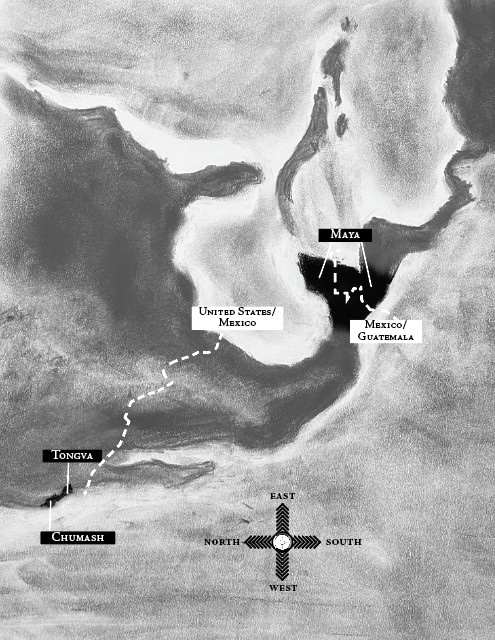
I was born and raised in Occupied Chumash lands in the fieldworker towns of Oxnard and Hueneme, one hour north of Los Angeles, the colonial settlement built on Occupied Tongva lands first by the Spanish Empire, then by the Mexican Empire, then the American Empire, and now by a global empire. I grew up in the 1980s in last decade of the Third World War in the United States of America (USA), where those who don’t listen to the pains of the below still call it the Cold War.
For many years my family did not have papeles, papers, documents granting legal permission to live and work in the United States. When I was little, my family regularly introduced me to their friends as la ciudadana, the citizen of the family, and everyone would stare as if I would do magic.
I am a first-generation college student, which means the generations before mine did not attend college. A first-generation college student is a sign of reaching the American Dream for an immigrant family, a sign of assimilation that makes the gringos, the Americans, be nicer to you. Depending.
In Guatemala, my family on all sides struggled with poverty. Quiquivix is a Mayan name, but we kids didn’t know that at first. Pronounced kee-kee-veesh, our teachers were convinced it was French. That used to feel like a relief. Most of my family refers to themselves as ladinos, the Guatemalan and Chiapas equivalent of the Mexican mestizos, mixed roots of Native, European, and often Afrikan that denies both the Native and the Afrikan, and whose great wish is to become closer to European. It’s like that in Guatemala and Mexico, too. It’s like that everywhere the Europeans colonized Abya Yala. Migrants already know before setting foot in the USA that it’s like it is back home: the ones in charge are nicer to you when your skin is a lighter color, and that if you can’t be White, then at least don’t be Black.
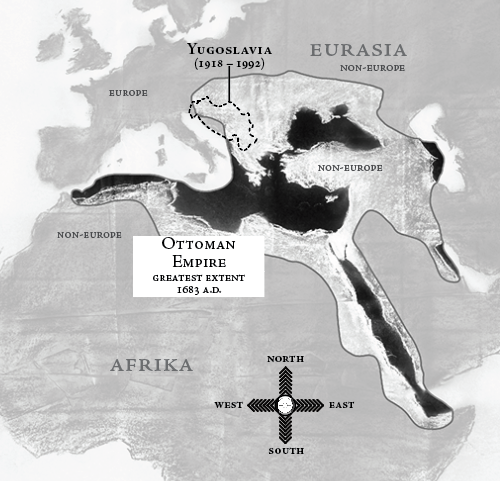
In our father’s assimilation journey into Whiteness, he had a more difficult time than most hiding his Native because his last name remained Mayan. He used to tell us Quiquivix had been Yugoslavian, originally spelled Kikovic and then changed along the way. Something about pirates shipwrecking in the Caribbean. It was his way of becoming closer to European not knowing he was picking the least European part of Europe, or maybe fully knowing and just happy with whatever part of Europe he could get.
Our mother is a survivor of domestic violence and helped us escape our father when were still little. She is the first who taught me about escape. She took us with her from Los Angeles to Oxnard to live with our grandmother, aunts, uncle, and cousins. Our grandmother knew some Mayan words. She had learned them from the Inditos at the mercado, she would tell us, the “little Indians” at the market. It wasn’t until later as a young adult when I first visited Guatemala that I would learn we had been Inditos, too.
As a child of migrants in the USA, pochas and pochos as we are called, I heard stories of being poor in Guatemala, but I didn’t know we were also poor in the United States until I started school and learned our shoes were telling everybody we were poor. In school I earned good grades and awards at first, misbehaved in adolescence when they split me up from my friends, almost didn’t graduate high school, and was able to catch up in time to go straight to college, straight to a working-class university.
I enrolled in the California State University Northridge (CSUN) in Los Angeles and began in August 1996, a month before the assassination of Tupac Shakur, presente. I majored in Business Administration with a specialization in Information Systems, another way of saying “the internet for business applications.” I was good at computers at a time when few people were good at computers. I chose that line of study because I would need to be employable after college to pay back my student loans, and everyone was saying you could land a job without a problem if you were good at computers.
In the business schools of the 1990s, the solution for everything seemed to be “globalization.” Globalization was helping everyone around the world get jobs, the professors were saying.
lobalization meant the whole world was becoming capitalist now. The so-called alternative to capitalism, the Soviet Union, had just collapsed. The experts were saying this triumph of capital had brought about the “End of History,” that there was no longer a fight about the future, no longer a fight between the capitalist “First World” and the communist “Second World.” Everybody was now embracing capitalism, everybody including the “Third World.”
In 1994, the Zapatistas in Mexico had risen up against capitalism, but none of my professors ever brought it up. My teachers talked instead about the “opening up” of Mexico and China, meaning, the exporting of the manufacturing jobs from where labor was expensive to where labor costs were cheap and environmental regulations hardly existent. Everywhere was opening up, everywhere that had been previously difficult for capital to enter was now opening up for sale.
The Soviet Union, its full name the Union of Soviet Socialist Republics (USSR), spanned Eastern Europe and Northern Asia and was headed off by Russia since its inception in 1922. Its collapse in 1991 marked the end of the war that was only cold between the USSR and its nuclear counterpart NATO.
NATO stands for the North Atlantic Treaty Organization and is another way of saying “Western Europe and its cross-Atlantic extensions.” NATO has been headed off by the United States, Western Europe’s most powerful cross-Atlantic extension, since NATO’s inception in 1949, shortly after Western Europe’s empires imploded in the Second World War. When the United States took over the imperial reigns, it launched a nuclear arms race against the USSR, its European rival to the east promoting communism instead of capitalism.
This badly named cold war was not cold for the Maya peoples in Guatemala. The 500-year-long extermination campaign of Columbus and Them intensified against the Maya during this time, even though the name of the genocider had changed from the Spanish Empire to the State of Guatemala. The State of Guatemala, like all states, is an instrument of force. It was assisted in its genocide by other instruments of force, namely America in the north and Israel in the east.
In 1954, the Central Intelligence Agency (CIA) of the United States helped overthrow the democratically elected president of Guatemala accusing him of communism for instituting land-back reforms. A banana corporation headquartered in the United States, the United Fruit Company, had arranged the government overthrow, launching what the textbooks would call a 36-year-long Civil War, but what my family simply called war.
In 1954, The President of Guatemala had been the second overthrown by the CIA. Iran’s President had been the first overthrown by the CIA the year before.
The CIA had been formed in 1947 in the first years of World War III. Its Iran operation had been coordinated with the British, who understood Iran’s Prime Minister, Mohammad Mosaddegh, as a threat for seeking to nationalize the Anglo-Iranian Oil Company. Shortly after Mosaddegh’s overthrow in 1953, the Anglo-Iranian Oil Company would change its name to British Petroleum, BP.
Presidents all over the world today sell the people and the land at the service of capital. It’s no wonder why. The ones who refuse are hunted, overthrown, assassinated. In 1961, the Republic of the Congo’s first Prime Minister refused to serve capital and was hunted, overthrown, assassinated. Patrice Lumumba, presente. In Chile, the CIA hunted the socialist-leaning president who ended up dead by the end of that day. Salvador Allende, presente. That year in Chile was 1973. The day fell on a September 11th.
During the Second World, the Soviet Union, had been fully complicit in intensifying the Third World War. In October 1962, the Soviets used Cuba as a launching pad for nuclear weapons pointed at the United States. From Cuba, the Soviet’s medium-range missiles could reach Washington, D.C. Known in the United States as the Cuban Missile Crisis and in the Soviet Union as the Caribbean Crisis and in Cuba as the October Crisis, the 13-day confrontation was regarded as the closest the world came to escalating into a full-scale nuclear annihilation.
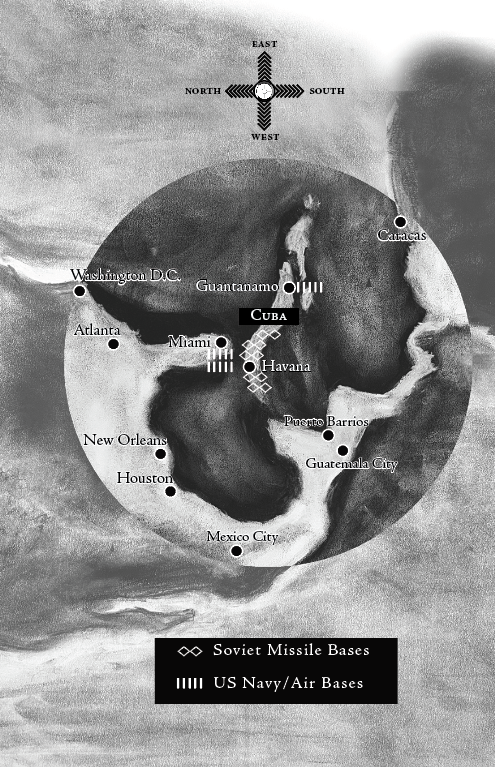
Notice the US Navy/Air Base in Cuba at Guantanamo on the map on the opposite page. Decades before the island’s colonial overseers would be overthrown by the Cuban Revolution of January 1, 1959, they had long ago leased Guantanamo to the United States with no expiration date.
In addition to serving as a military base, since the September 11, 2001 attacks on the United States, Guantanamo has also served as a detention camp and torture center for hundreds of people kidnapped by the United States in its Global War on Terrorism, a war with no bounded geographies, a war with no limits, a war without end.
Empire’s current newspaper of record reports that as of May 2024, Guantanamo has been used to detain about 780 people from 48 different countries. Today, 30 remain, of which only 11 have been charged. Out of the hundreds detained since 2002, only 16 have ever been charged with criminal offenses.[2]
World wars did not stop with the fall of the Soviet Union. The situation has continued to be war everywhere except between the ones with the nuclear weapons, further encouraging others to develop nuclear weapons.
With every war since 1991, those who keep their gaze with the above keep asking if we’re on the brink of a Third World War or call the current war a “New Cold War.” But is it not still war even when the war is cold for the above but still hot for the below?
This has been excerpt of Palestine 1492: A Report Back, by Linda Quiquivix
Footnotes
[1] William C. Anderson, The Nation on No Map: Black Anarchism and Abolition (AK Press, 2021)
[2] “The Guantanamo Docket,” New York Times (May 24, 2024)