This is an excerpt of Palestine 1492: A Report Back, by Linda Quiquivix
Israel’s military siege on the Nativity Church took place between April–May of 2002. It was the time in Bethlehem when Israel shot up the church built on the spot where tradition holds Jesus of Nazareth had been born. For 39 days, Israel’s military trapped hundreds of Palestinian fighters, civilians, nuns, and monks inside the Church while shooting at them through the windows and withholding from them water, electricity, food, and medicine. This happened during the Second Intifada, the Palestinian uprisings across the West Bank and Gaza Strip between 2000–2005, territories that together were supposed to have already become a State of Palestine, according to the lie that was the peace process.
The two-state solution of the poorly named “peace” process had been secretly agreed to in Oslo, the capital of Norway, between Israel and Yasser Arafat and signed on the White House lawn in September 1993. Israel agreed to participate as to prevent it further embarrassment during the First Intifada, the Palestinian uprisings across the West Bank and Gaza Strip between 1987–1993, a previous time, before it happened again in 2023, when the world witnessed Israel as the overwhelming aggressor through widely circulating images.
The Second Intifada had been sparked by Israeli Prime Minister Ariel Sharon’s storming of the al-Aqsa Mosque compound in Occupied Jerusalem with a thousand heavily armed police and soldiers on September 28, 2000. By then it was already clear the peace process had been a lie. It had resulted in peace only for Israel, and created the collaborationist Palestinian Authority, the PA, to police Palestinians on behalf of Israel. Israel never stopped occupying, displacing, shooting, killing, and imprisoning Palestinians throughout; Israel never stopped taking more land in the West Bank and Gaza Strip, the 22% left of Historic Palestine.
I had learned about the Nativity Church Siege in a photojournalism course the year after it happened. I was still in the undergraduate program at the California State University Northridge satisfying a long-held curiosity about how dark rooms worked. Studying photojournalism answered that question and left me asking many more. The night we studied the photographs of the Siege, I had known nothing about the Siege or the Church, but I was conscious I was hearing about Palestine again. A staff photographer from the Los Angeles Times had snuck inside the Church during the Siege with her digital camera, becoming the only Western journalist to capture the story from inside. She had passed her memory cards to a Palestinian priest for safekeeping before leaving the Church, knowing Israel would seize her equipment. Her photographs would survive, circulated widely, and be nominated for the most prestigious prize in American journalism. As our professor recounted the story, I paid attention to how he spoke about the Palestinians. He was sympathetic.
After graduating from the master’s program in June 2005 and about to move to North Carolina for the doctoral program that August, I quit my job and spent my savings and my summer backpacking around the world with my camera, wondering if I could become both a photojournalist and a geographer. That summer of travel began in China, where I had been invited to present my work in an international geography conference on borders. Chinese geographers toured us around the region’s Golden Triangle, where the borders between China, Thailand, Myanmar, and Laos meet. After that, I traveled to Cuba, Venezuela, and Argentina without much idea of what I would find, but I kept hearing the resistances there were strong.
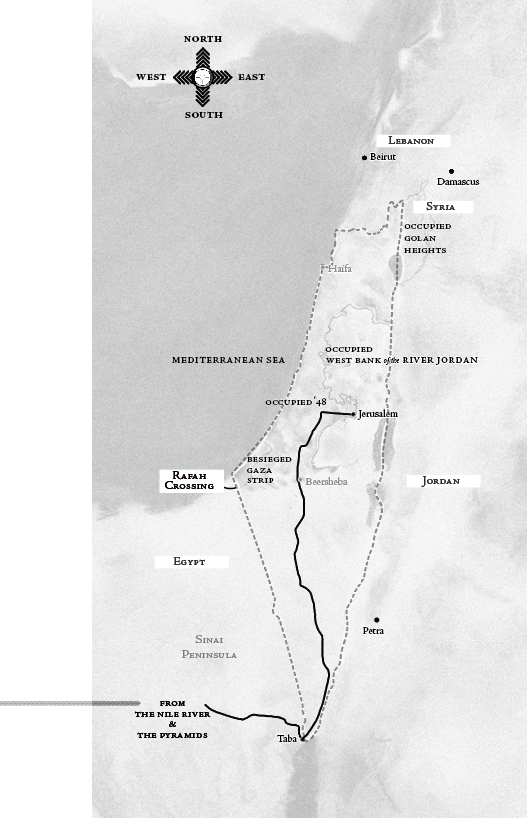
When my first semester at the University of North Carolina at Chapel Hill ended in December 2005, I immediately boarded a plane to backpack Syria, Lebanon, Jordan, Egypt, and Palestine, back when I was still referring to the land as Israel/Palestine. I began planning that trip two months before after noticing a travel guidebook for the region had a single paragraph toward the back addressed to “Solo Women Travelers,” letting me know it had been done before. As had happened with many people in the United States with the 2003 invasion of Iraq, I was convinced that the corporate media was lying, I just didn’t yet know how much.
I landed in Syria one midnight in December with a layover first in Istanbul, where the snowflakes outside the airplane window are still the largest I have seen. At the Damascus airport, I encountered all men. They were all respectful. I took a taxi to a hotel, woke up the next day, and peered out the window, hesitating a little to go outside. I wondered what I should wear. Only in Saudi Arabia and Iran are women forced to cover their hair.
I wandered around in Damascus with my camera trying to blend in, unsure of what I would find, discovering a new world, trying not to photograph too much. The Umayyad Mosque, embroidered dresses, colorful veils, pistachio ice cream. Damascus is one of the oldest continuously inhabited cities in the world, and the Umayyad Mosque is where they say the head of John the Baptist is buried.
Syria’s border with Lebanon was so close, I was able to hop on a taxi from Damascus to Beirut, parts of which reminded me of the Los Angeles party scene with the occasional bombed out building next door. From there, a bus to Jordan to hike the pink stone city of Petra. I didn’t stay long in the capital city, Amman. The city had a series of hotel lobbies bombed by Al-Qaeda the month before. I asked a taxi driver if we could go see the border between Jordan and Iraq, and he refused right away. From Jordan, a bus to Egypt to see the Nile River and the pyramids. It was now January 2006, only three days would be left after Egypt for Palestine before my return flight from Tel Aviv. I had wished to visit Gaza’s border with Egypt but was told it was hard to get in. The bus took the longer way, from Egypt to the southern tip of Palestine before turning north to reach Jerusalem. Throughout the bus ride and our stops in between, the televisions were reporting Israeli Prime Minister Ariel Sharon had just suffered a stroke.
We arrived in Jerusalem at midnight. I slept in the lobby of a hostel and checked in the next morning. In the lobby, an American-Israeli settler talked about the Palestinians the way White people used to publicly talk about Black people in the United States. “Didn’t the Israelis take the Palestinians’ homes?” I asked him not as a challenge but as a genuine question. The settler frowned at me as if I were ignorant and dumb. He left. Interactions like these helped me become less confused about Palestine. After being racially profiled by Israel at the airport on my way back home and forced to undress helped me become a lot less confused.
I had gone to Palestine to see what I would learn, making no plans other than to see in person the Dome of the Rock, Israel’s Wall, and the Nativity Church, not knowing one day I would return.
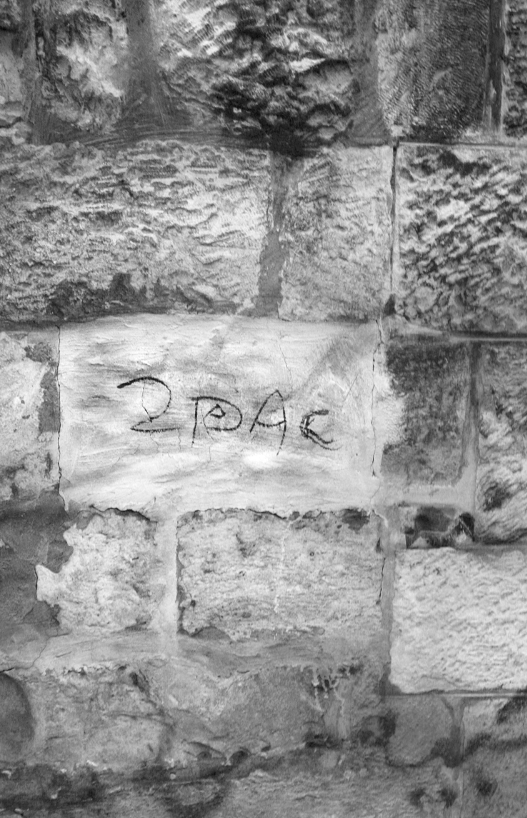
My first morning in Jerusalem I was greeted by Tupac tagged on a brick, 2Pac. It became the first photograph of Palestine I would take. (January 5, 2006)
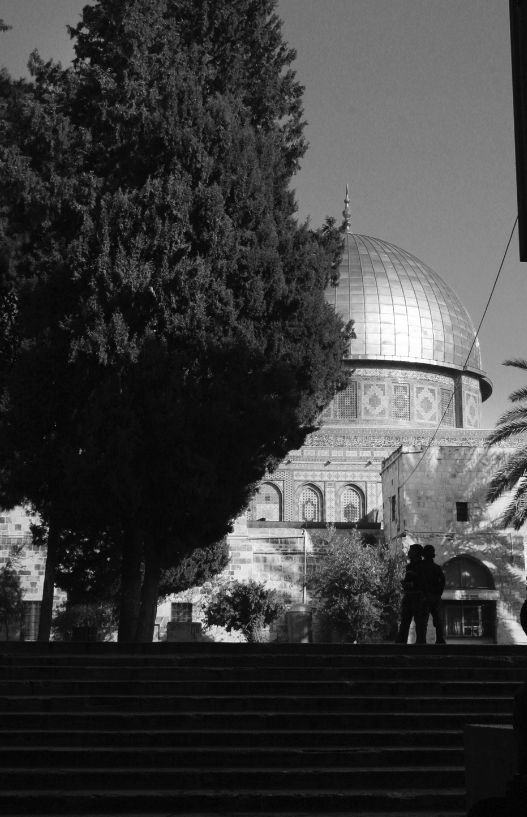
The Dome of the Rock in Jerusalem is the centerpiece of the al-Aqsa Mosque compound. It was built in the years 691–692 on the site of the destroyed Second Jewish Temple, destroyed by the Roman Empire in the year 70. The Second Temple’s western wall still remains, where today Jews still go to pray. Al-Aqsa is often depicted in Palestinian resistance imagery as a sacred geography that contemporary maps have a hard time depicting. Jerusalem was the first direction Muslims prayed before it shifted to Mecca. (January 5, 2006)
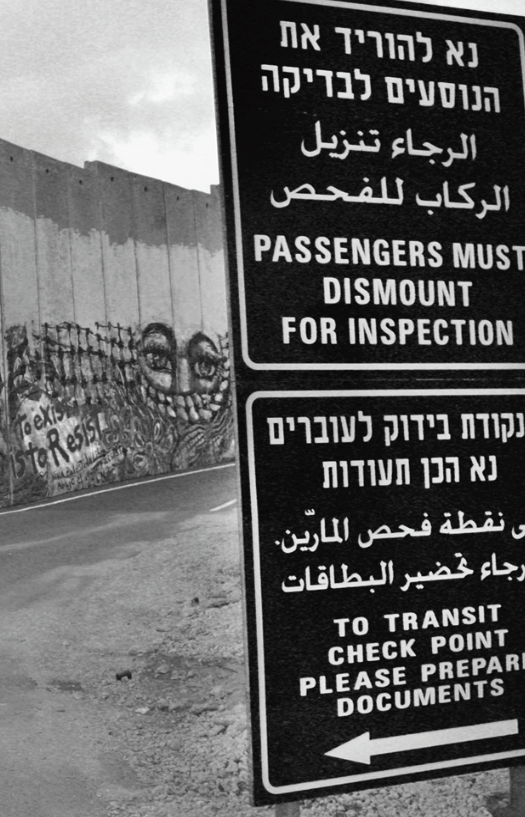
The next day, a Palestinian taxi drove me the five miles south from Jerusalem to Bethlehem. Israel’s Apartheid Wall was as far as he would go. I’d have to walk myself through and find the rest of my way.
This was in the fourth year of the Wall’s construction. Since that time, a more fortified checkpoint with 24-hour Israeli military presence exists. Palestinians are not allowed to cross from the West Bank into Jerusalem.
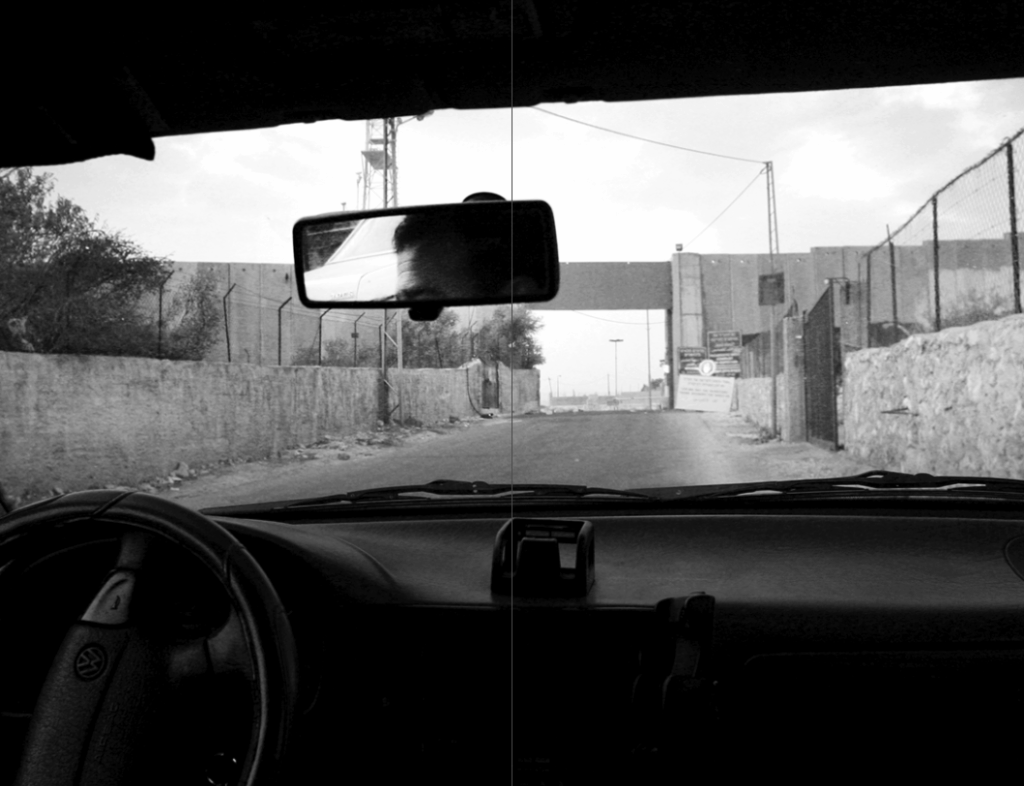
Aida Refugee Camp is on the other side of the wall, directly to the right. We wouldn’t know it yet, that we would soon accompany each other, Aida Refugee Camp and me. (January 6, 2006)
Four years later when Salah Ajarma would ask me to map Aida Camp in 2010, I didn’t know he had been one of the Palestinians besieged inside the Nativity Church eight years before.
When Rachelle and I found out and shyly asked him, he was happy to meet us at the Church and share the story. Salah showed us the bullet holes that remain on the walls and pointed to the windows Israel shot through; he introduced us to the pillars that shielded them from bullets as they slept; he presented us to the trees that provided their last leaves when food was running scarce; he pointed to the walls from where neighbors tossed bags of food that avoided the soldiers’ gaze; he recounted the story of how he and his sweetheart, his soon-to-be wife Rasha, had kept in touch throughout those 39 days.
Salah also shared that the sacred altar down below, the grotto where a star marks the spot of the manger, was the warmest, quietest, safest place and became a healing space, a clinic tending to Palestine’s wounded during the siege.
When Israel lifted the siege, it expelled several Palestinians to countries outside of Palestine and many to the Gaza Strip where only five years later in 2007, they would live once again under siege, a siege that still has not ended for the ones who are still living.
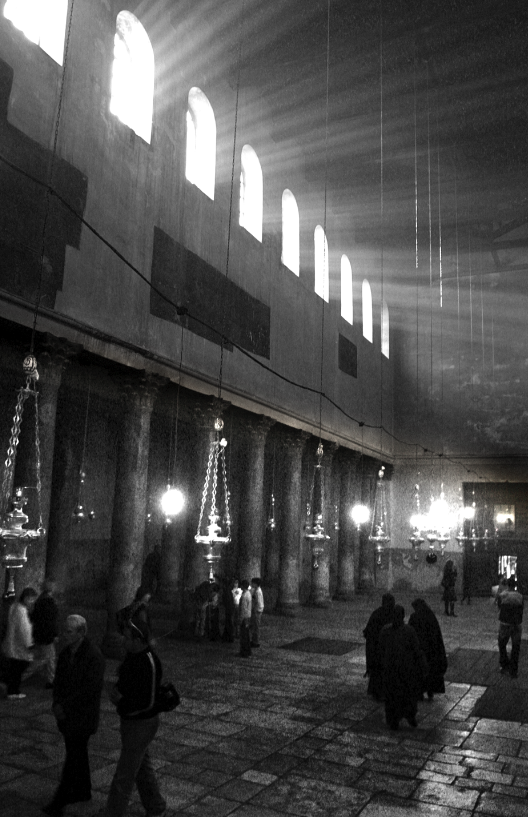
This is a photograph I took on January 6, 2006 the day I first met the Nativity Church. I had no idea I would soon return to Palestine and learn to struggle from a Palestinian like Salah Ajarma, presente.
Six months later was summer 2006. I was in Guatemala and Southern Mexico preparing for my doctoral research on the Mexico/Guatemala border. On the Chiapas the side of the line, in San Cristóbal de las Casas, I was curious to learn more about the Zapatistas. The old colonial city, literally named after Columbus and Them, was where the statue of the colonizer Diego de Mazariegos had been knocked down that October 12, 1992. The Zapatistas had taken San Cristóbal during their uprising that January 1, 1994. Nobody in San Cristóbal I could find could tell me about the Zapatistas, or maybe they did not want to.
At the outdoor mercado of the Maya Tzotzil communities, the Zapatista image was almost everywhere, handmade wool figurines and Subcomandante Marcos t-shirts to satisfy the Zapa-tourists like me, who think they can go to San Cristóbal de las Casas and find the Zapatistas but all they get is a Zapatista t-shirt. It would be a little longer before I learned what the Zapatistas had been doing that summer of 2006, and more of who they really were.[1]
It was July 2006. In my hotel room, CNN International was reporting something about Beirut. Israel had just bombed the airport. It hit me different this time, and it went on for days. The coverage on CNN in English on my laptop was different from CNN International and CNN en Español. The Spanish-language channel had invited a professor to provide education, background, history, history meaning the Nakba of 1948, not simply a history of the week before. CNN in English was vilifying Lebanese and Palestinians alike, humanizing only Israelis, repeating Condoleezza Rice’s shoulder shrug at war, the “growing pains of a new Middle East,” as she had put it.
I used to struggle to describe that realization as an unbearable heartbreak, to stare at the lie from the face of the ones you used to trust while seeing reality reported from somewhere else. I still struggle to describe it. It entailed a lot of crying. Since then, millions of more hearts have been broken to realize how easily Holocausts can still happen, often do happen and well beyond Palestine.
Congo, Haiti, Sudan, presentes.
The world as I had known it died that summer in Chiapas with my gaze to Palestine. Back at school, I couldn’t do any of my work. My time was spent researching and learning everything I could about Palestine, speaking about Palestine to everybody I could. My doctoral adviser, Altha Cravey, supported me in doing something few advisers would do. I changed my entire doctoral project to research the borders of Palestine, even though I didn’t speak the language and didn’t know anybody there. I don’t know if I would have finished the program were it not for that change.
A blog in English called Gaza Mom shared a mother’s attempts to cross the Gaza/Egypt border at Rafah with her little boy, a border more often closed than it was opened. People would die while waiting for Israel and Egypt to open Rafah, babies would be born while waiting at Rafah. Leila El-Haddad was the writer. Her blog described the devastating conditions in the Gaza Strip and Israel’s total control even after removing its settlers from there in 2005 and transferring them to the West Bank to terrorize Palestinians there. The Gaza Strip was already devasting before the Israel began its full siege in 2007, starving Palestinians from food, water, electricity, medicines, “putting them on a diet,” as Israel has liked to say, “mowing the lawn” as it described its regular carpet-bombing campaigns.
I wanted to learn as much as I could and attended awareness events and then organized them on campus. I lost a lot of friends; I gained a lot of friends. I began to write publicly, openly critical of Israel and Zionism, knowing full well the consequences. Phone calls were made to my university demanding I be expelled. Emails reached my inbox containing death threats from people who wouldn’t show their face and name. In one of the nicer pieces of hate mail, a Zionist let me know they hated my politics but loved my writings. They had read an essay where I mentioned my mother’s last name and revealed to me, Your mother’s name is a Jewish Sephardic name from Spain, so mazel tov, congratulations, you’re Jewish, too! I thought that part was cool, but it wasn’t going to make me a Zionist.
In December 2008, Israel carpet-bombed the Gaza Strip for the first time. Barack Obama had just won his first presidential election. He was silent although they say he had been mentored directly by the late Edward Said. Operation Cast Lead, as Israel called its massacre, lasted well into January 2009. Israel ceased fire days before Obama’s inauguration, preventing the Historic moment of a first Black head of the U.S. empire from being tainted by reality.
At the same time in Chiapas, the Festival of Dignified Rage had been convoked by the Zapatistas. The Palestinian people were brought up in every session and roundtable that week. On January 4th, 2009, while Israel’s white phosphorus was still raining down on Gaza, the Zapatista spokesperson paused the Festival to speak the following words:
Maybe, what I am about to say has nothing to do with the main theme of this roundtable, or maybe it has.Two days ago, the same day in which our word spoke of violence, the ineffable Condoleezza Rice, U.S. government official, declared that what was going on in Gaza was the fault of the Palestinians, due to their violent nature.
The subterranean rivers that run through the world are able to change their geography, but they sing the same song.
And the river we now listen to sings of war and grief.
Not far from here, in a place called Gaza, in Palestine, in the Middle East, just next door, a heavily armed and trained army, from the Israeli government, continues its advance of death and destruction.
The steps it has followed so far are those of a classic military war of conquest: first a massive and intense bombardment to destroy “neuralgic” military posts (so they are called by military manuals) and to “soften up” resistance fortifications; then an iron grip on information: everything that is heard and seen “in the outside world”, that is to say, outside of the theatre of operations must be selected according to military criteria; now intense artillery fire over enemy infantry to protect the advance of troops to their new positions: after that an encirclement and siege to weaken the enemy garrison; then an assault to conquer the position by annihilating the enemy; finally, the “cleansing” of the probable “nests of resistance”.
The military manual of modern warfare, with some variations or additions, is being followed step by step by invading military forces.
We don’t know much about this, and it is certain that there are specialists on the so called “conflict in the Middle East”, but from this corner, we have something to say:
According to the photos from news agencies, the “neuralgic” military posts destroyed by the Airforce of the Israeli government are houses, huts, civil buildings.
We have not seen any bunkers, barracks, military airports or cannon batteries among what has been destroyed. Then, we think, excuse our ignorance, that either the aircraft gunners have bad aim or in Gaza there are no such “neuralgic” military posts.
We don’t have the honor of having visited Palestine, but we suppose that in those houses, huts and buildings used to live people, men, women, children and elderlies, and not soldiers.
We have not seen resistance fortifications either, only debris.
What we have seen, is the so far futile effort to cordon off information and several governments of the world wavering between playing the fool or applauding the invasion, and a UN, already useless way back, publishing lukewarm press releases.
But wait. It now occurs to us that perhaps, for the Israeli government, these men, women, children and elderly people are enemy soldiers and, as such, the huts, houses and buildings where they live in are barracks that need to be destroyed.
And the enemy garrison that they want to weaken with the encirclement and siege of Gaza is none other than the Palestinian population living there. And that the assault will seek to annihilate that population. And that any man, woman, child or elderly person who manages to escape, by hiding from the predictably bloody assault, will then be “hunted down” so that the cleansing can be completed, and the military chief in command of the operation can report to his superiors “we have completed the mission.”
Excuse our ignorance again, perhaps what we are saying is, in fact, beside the point. And that instead of repudiating and condemning the crime in progress, as indigenous people and as warriors that we are, we should be discussing and taking a position on the discussion about whether it’s “Zionism” or “anti-Semitism”, or that it was the Hamas bombs that started it.
Perhaps our thoughts are very simple, and we lack the nuances and the always very necessary marginal notes in the analysis, but, for us Zapatistas, in Gaza there is a professional army assassinating a defenseless population.
Who from below and to the left can remain silent?
-*-
Is it useful to say something? Do our screams stop any bombs? Is our word saving the life of a Palestinian child?
We think that it is useful, maybe we will not stop a bomb nor will our word become an armored shield that prevents that 5.56 mm or 9 mm caliber bullet, with the letters «IMI» («Israeli Military Industry») engraved on the base of the cartridge, from reaching the chest of a girl or a boy, but maybe our word will manage to join with others in Mexico and the world and maybe first it will become a murmur, then a loud voice, and then a cry that will be heard in Gaza.
We don’t know about you, but we Zapatistas of the EZLN know how important it is, in the midst of destruction and death, to hear a few words of encouragement.
I don’t know how to explain this, but it turns out that words from afar may not be enough to stop a bomb, but they are as if a crack opened in the black room of death for a small light to slip through.
Otherwise, what will happen will happen. The Israeli government will declare that it has dealt a severe blow to terrorism, it will hide the magnitude of the massacre from its people, the big producers of weapons will have gotten an economic break to face the crisis and “world public opinion,” that malleable entity, always in tune with the situation, will turn to look the other way.
But not only. It will also happen that the Palestinian people will resist and survive and continue fighting and continue to have sympathy for their cause from those below.
And perhaps a boy or girl from Gaza will survive too. Perhaps they will grow and, with them, anger, indignation, rage. Perhaps they will become soldiers or partisans for one of the groups fighting in Palestine. Maybe he or she will face combat against Israel. Maybe he or she does it by firing a rifle. Maybe by blowing himself up with a belt of dynamite sticks around his waist.
And then, up there, someone will write about the violent nature of the Palestinians and make statements condemning that kind of violence and there will be another debate about whether Zionism or anti-Semitism.
And then no one will ask who sowed what was reaped.
On behalf of the men, women, children and elderly of the Zapatista Army of National Liberation.
Subcomandante Insurgente Marcos
Mexico, 4th of January 2009.
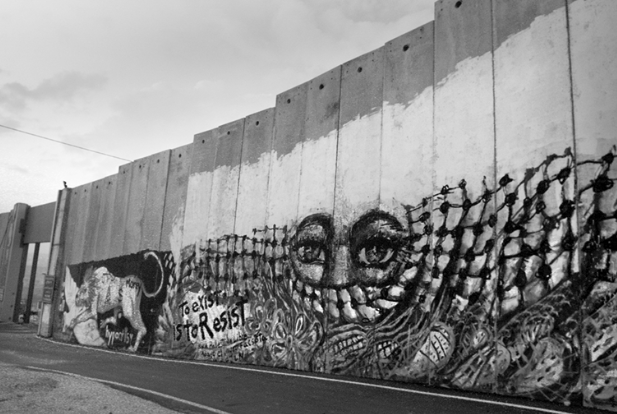
On my first trip to Palestine, I had noticed a mural on the Apartheid Wall on the Bethlehem side of the checkpoint. The painting had eyes peering through a keffiyeh, surrounded by maize and the words “To exist is to resist, Viva Palestina libre, abajo el muro fascista, EZLN” Long live a free Palestine, down with the fascist wall, EZLN. (January 6, 2006)
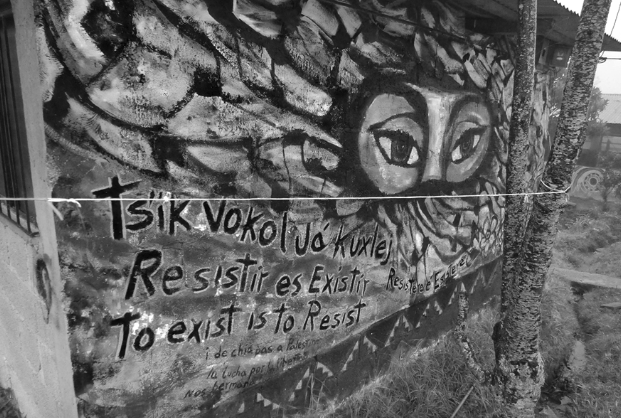
Years later in Zapatista territory with Palestinian compas returning from the Little School we noticed a similar mural on a building in Oventik, in Maya Tzotzil lands. It read “To exist is to resist” in four languages: Tzotzil, Spanish, English, and Italian along with “¡De chiapas a palestina la lucha por la libertad nos hermanece!” from Chiapas to Palestine, the struggle for freedom makes us kin! (January 1, 2014)
This has been excerpt of Palestine 1492: A Report Back, by Linda Quiquivix
Footnotes
[1] El Kilombo Intergalactico, Beyond Resistance: Everything, An Interview with Subcomandante Insurgente Marcos (Paperboat Press, 2008)