This is an excerpt of Palestine 1492: A Report Back, by Linda Quiquivix

𝋡
Soon after being purged from the Nation of Islam for being a truth-teller, Malcolm X borrowed money from his sister and traveled to Afrika and the Middle East in 1964. For what would be the final year of his life, he came back reporting that “travel broadens your scope,” sharing in speeches and interviews his learnings about anti-colonial struggles outside the United States, the place he knew best.
While visiting Mecca in pilgrimage as a Muslim, Malcolm received the Arabic name El-Hajj Malik El-Shabazz. While visiting newly independent Nigeria to deliver a speech, he received the Yoruba name Omowale, meaning “The son who has come home.”
While in newly independent Ghana, he met the ambassador to the newly independent Algeria and refined his analysis on Whiteness. To the Algerian ambassador, he had shared his worldview of Black nationalism before realizing the Algerian ambassador, a revolutionary, was white. Of this encounter, Omowale, El-Hajj Malik El-Shabazz, Malcolm X shared:
When I was in Africa in May, in Ghana, I was speaking with the Algerian ambassador, who is extremely militant and is a revolutionary in the true sense of the word (and has his credentials as such for having carried on a successful revolution against oppression in his country). When I told him that my political, social, and economic philosophy was Black nationalism, he asked me very frankly, well, where did that leave him? Because he was white. He was an African, but he was Algerian, and to all appearances, he was a white man. And he said if I define my objective as the victory of Black nationalism, where does that leave him? Where does that leave revolutionaries in Morocco, Egypt, Iraq, Mauritania? So he showed me where I was alienating people who were true revolutionaries dedicated to overturning the system of exploitation that exists on this earth by any means necessary. So, I had to do a lot of thinking and reappraising of my definition of Black nationalism. Can we sum up the solution to the problems confronting our people as Black nationalism? And if you notice, I haven’t been using the expression for several months. But I still would be hard pressed to give a specific definition of the overall philosophy which I think is necessary for the liberation of the black people in this country.
In another speech delivered only hours after his house was firebombed on February 14, 1965, and only a week before his ultimate assassination, Omowale, El-Hajj Malik El-Shabazz, Malcolm X again reported back on worlds where people are white only “incidentally,” where white does not mean they’re The Boss, where white was only a description, an adjective, not a noun.
In the dominant world, far more global today than during the time of Omowale, El-Hajj Malik El-Shabazz, Malcolm X, white-adjective continues to be entangled onto White-noun, beings designated as superior within a world structure of superior vs inferior against beings who are black-adjective, against beings marked as Black-noun.
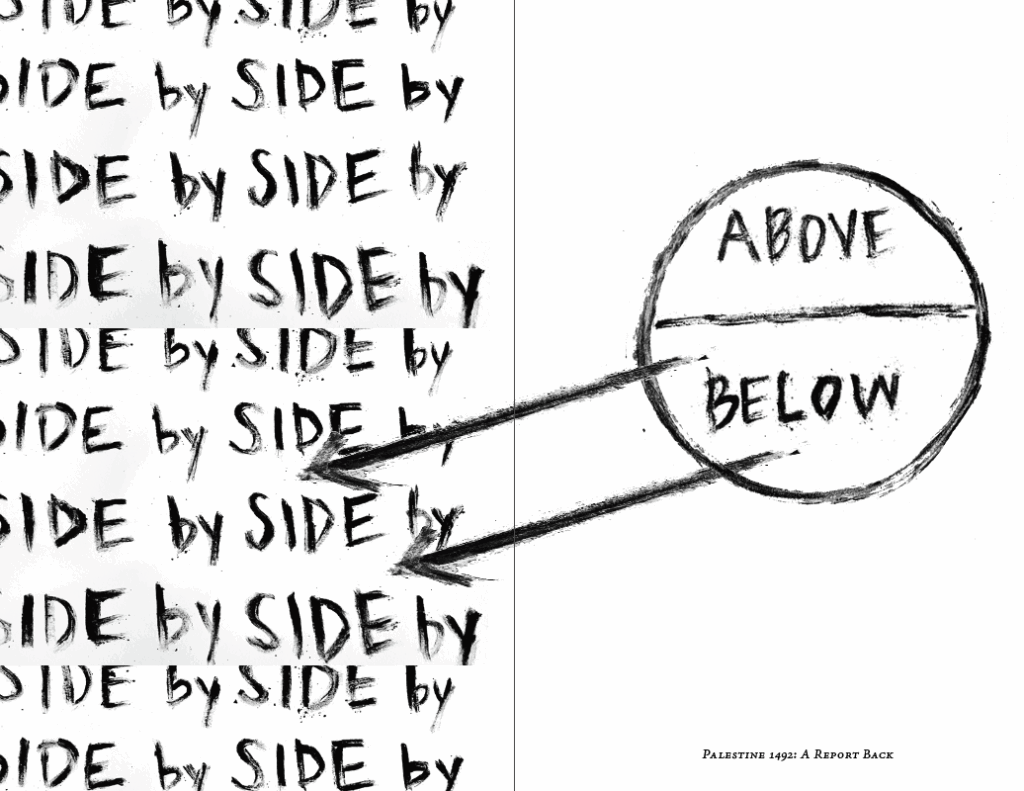
white-adjective vs black-adjective. White-noun and Black-noun together, but above vs below, not side by side. White supremacy and anti-Blackness together, two poles of the dominant world, two poles of the world of 1492, two poles of the world even before, of Asia’s world even before. Not the same as Human vs non-Human. White vs Black is Human vs anti-Human.
Omowale, El-Hajj Malik El-Shabazz, Malcolm X didn’t get to live long enough to develop his overall philosophy. I wonder how much more healing there might have been on earth had he not been martyred when he was. I wonder who are the ones taking up the project he left behind. I wonder if maybe we all should be taking up the project he left. Liberation is at stake.
Is the task of White people, is the task of the ones who believe they’re the Boss because they’re incidentally white, is the task of White people to split apart white-adjective from White-noun? Is it the task of White people, is it the task of the ones who want neither the privilege nor the sociopathy, is it the task of revolutionary White people to split apart their incidental whiteness from White-I’m-Boss?
Can the two split? For a world where all the worlds fit, they must be split. How can they be split? And after the split, after white-adjective’s escape, how might white-adjective evade re-capture into White-noun? The seductions to remain captive are great. Captive to privilege. Captive to sociopathy. Captive to empire. And everybody knows the Devil’s temptations to stay captive are great.
I have heard white-adjective people refuse the label White and think it’s enough while the world continues treating them as White, while the hospitals, the schools, the workplaces, the courts, the prisons, the state not only see them as white, they treat them as White, and while everyday people treat them as White. One cannot say they are not White when the world treats them as White, whether one likes it or not.
The world itself is a problem. It is a problem of the world. It is a problem of an anti-Black world. It is a problem of a system structured by domination, by above vs below, making it difficult for us to share the world together, side by side… by side by side.
Everybody knows the Devil’s seductions are great.
𝋢
The first time I heard about sharing the world side by side as an alternative to above vs below, I was listening to Sylvia Marcos speak in Chiapas for the first time. The Mexican intellectual was quoting the Palestinians on the challenge of hope.
The day was January 1, 2013, the 19th anniversary of the Zapatista uprising. We were gathered with a thousand others from around the world at the Indigenous Center for Integral Capacitation (CIDECI) near San Cristóbal de las Casas, at its Third International Seminar of Analysis and Reflection, “Planet Earth: Anti-Systemic Movements.”
Sylvia was speaking alongside autonomous movements from Mexico and around the world, from the Purépecha peoples in Cherán to the Mapuche peoples in Chile. She was joined by other movement elders, including artist Emory Douglas of the Black Panther Party; the late Zapatista intellectual Pablo González Casanova; and the late architect and militant intellectual Jean Robert, Sylvia’s life partner.
When Sylvia spoke that day, she described the march of over 40,000 Maya Zapatista men, women, and children throughout Chiapas that had just taken place on the 21st of December of 2012, the end of the Maya long count. The Zapatistas had marched quietly that day with no single leader, with all of them leaders. Each stepping up on a stage they built and transported with them for the occasion, and stepping down off stage just as quickly, juntos y a la par, together and side by side. Sylvia emphasized that part, “together and side by side.” I soon learned it is the focus of her work on Mesoamerican philosophies and worldviews.
Together and side by side is a Zapatista women’s demand, philosophy, and practice of walking alongside the Zapatista men in struggle, in a complementarity of difference rather than in a competition. That is, they do something very other than repeat the logic and practice inherent to domination, inherent to patriarchy. When Sylvia ended her offering that evening with, “We have to expect to be prisoners of hope, like the Palestinians say,” I knew I needed to introduce myself.
I was in attendance as a listener seeking to weave more between Chiapas and Palestine, seeking to organize a Palestinian delegation to Zapatista territory. I had just encountered the right person. When I shared with Sylvia my task, she responded, “I am Palestinian. My grandparents were from Bethlehem.” We embraced.
The next year in her home, we gathered with a Palestinian delegation of women, all of us having returned from week-long stays in Zapatista territory as students in their Escuelita, their Little School. We exchanged our experiences and remarked on the weavings between Chiapas and Palestine, present in different degrees in both geographies.
Each Little School student had received four textbooks: Autonomous Government I; Autonomous Government II, Autonomous Resistance; and Women’s Participation. We were given time to read them while visiting the Zapatistas’ autonomous clinics, schools, food gardens, cooperatives, and justice systems, and while sharing back with them how we were organizing where we lived, what our struggles looked like.
Sylvia shared from her Little School experience by outlining the ways the Zapatista Women’s Revolutionary Law of 1993 was being lived in the present, as detailed in the textbook Women’s Participation. She was writing an essay pulling out the philosophical foundations of the Zapatista women’s struggle against patriarchy and emphasized a fluid dualism between men and women, not a binary dualism of Western feminism that responds to patriarchy by reversing the positions of domination, that responds by placing women as superior to men in struggle. The Zapatista women insist that their struggle is to live together and side by side, women and men, not above vs below.
I offered to translate her essay, published that year in 2014 as “The Zapatista Women’s Revolutionary Law as it is lived today,” and in the process, I received from Sylvia some conceptual curanderismo, some conceptual healing. She helped me shake off the notion that all dualisms were bad, that all dualisms were binary, that all differences were in competition. She spoke of worlds of complimentary opposites and of fluidity in between.
Sylvia’s work intervenes against Western approaches to feminist justice that focus on switching the positions of domination between men and women, and on making demands for sameness between genders, for women to become oppressors like the men under patriarchy. Her writings instead emphasize the Mesoamerican worldview of difference existing “together and side by side” and the Zapatista women’s practice of walking alongside Zapatista men in struggle while being “the women that we are,” an insistence on difference, a complementarity of difference, not a binary competition toward a standard, toward sameness.
The call to respect difference rather than to tolerate difference was still new to me. Sylvia pointed me to another Zapatista phrase to help me shake it off: “We are equal because we are different.” I sat with that one, thinking about the definition of equality I had previously been taught: citizenship, and that to attain citizenship, several boxes had to be checked off, meaning a standard had to be met to attain equality, and that once a standard for equality was introduced, inequality was at the same time introduced.
If we begin with “We are equal because we are different,” then rather than being weak because of our differences, we are strong because of our differences, not in spite of them. When I asked Sylvia from where this wisdom came, she simply replied “It’s in nature.” Wisdom is observed all the time in nature.
𝋣
The Little School taught me most about the land. It taught me the way I was fighting for the land was all wrong. The land is not just a moral imperative; land is the condition of possibility for the creation of another world. It taught me the struggle is not just about taking back the land but about what kind of life is made possible with the land, about what kind of world can be built together with the land, side by side with the land.
For three days in a Maya Zapatista household, the compas fed me, sheltered me, protected me in the world they had designed to be autonomous from the dominant world. I wouldn’t have been able to repeat it back home. I only knew to pay someone for everything I needed back home. I could say I was anti-capitalist all I wanted, but as long as I needed money in order to live, I wouldn’t know how to live without capitalism.
I eventually made my way back home to Oxnard, California, in the United States, a country where almost nobody knows how to live without capitalism. A place where almost nobody wants to build together with the land. Land in Oxnard is used for industrial agriculture. We are told as children to stay away from the land. We are told as children to go to school instead, where we learn some more to stay away from the land.
Oxnard is a place where food growing is intensive and back breaking, where each field has only one crop, sameness and sameness for acres and acres, where everything different is -cided: pesticided, insecticided, herbicided; where the relations between plants and animals and between plants and other plants is forced into a competition for life.
Without any access to land, I learned to grow food first in pots and then in a community garden where I experimented growing a small milpa like my grandmother and mother, where maize, beans, and squash grow together and support each other rather than compete against each other.
The maize grows tall, and is the centerpiece of the milpa, a heavy feeder of the soil and is known as the leader. The bean plant crawls up the maize fixing food back into the soil, and of the three it is called the giver. The squash stays low to the ground, its large leaves covering the soil and is known as the protector. All three plants in a complementarity of difference, not a binary competition toward sameness. All three plants complimenting each other, together and side by side. Maybe from observing their wisdom, by learning to listen we might learn how to build the world anew.
We can say we are anti-capitalist all we want, but how many of us know how to live without capitalism?
We can say we are anti-patriarchy all we want, but how many of us know how to live without patriarchy?
We can say we are anti-domination all we want, but how many of us know how to live without domination?
How many of us know how to get to that world of side by side by side by side? And if we don’t know, how many of us wish to start?
This has been excerpt of Palestine 1492: A Report Back, by Linda Quiquivix
Footnotes
[1] Malcolm X, “The ‘Young Socialist’ Interview” in By Any Means Necessary (Betty Shabazz and Pathfinder Press, 1970)
[2] El-Hajj Malik El-Shabazz, “The Last Message” (February 14, 1965)
[3] Sylvia Marcos “The Zapatista Women’s Revolutionary Law as it is lived today,” openDemocracy (July 2014)