This is an excerpt of Palestine 1492: A Report Back, by Linda Quiquivix
𝋡
Sun Tzu’s The Art of War, a text written roughly 2,500 years ago, was traditionally kept secret among the generals and the kings who didn’t want the soldiers studying strategy; the soldiers might overthrow the generals and the kings. Soldiers were trained only in tactics, meaning they were never trained at reading and managing the bigger fire, only at starting fires, putting out fires, and reporting there’s a fire. Today, The Art of War is widely available but few seem to read it outside business schools and corporate board rooms, as if more evidence were needed that capital is war.
It’s important to note The Art of War is a book about a specific type of strategy: military strategy, the zero-sum game of win or die. Reading it can turn your stomach when you realize the enemy it’s talking about is you, your community, your world, your planet earth. The challenge when studying military strategy is to learn to defend ourselves, our communities, our worlds, our earth by not becoming the monsters that we fight, to study strategy beyond the military type of above vs below, and study how to circulate power side by side, all while respecting our differences in both collective and individual forms. That is, all while building the world anew as we shake off the old, together at the same time.The ethics of who we wish to become while in war may be why we need strategy most. Bare survival pits us against each other, and without strategy there’s always a fight, never a question of how to fight, when to fight, or if to fight. Without strategy it’s just constant fights. Sun Tzu:
To win one hundred victories in one hundred battles is not the acme of skill. To subdue the enemy without fighting is the acme of skill.
An old mentor used to tell us, Our task is not to express our outrage but to organize against the source of our outrage. Organizing requires strategy. Mobilizing can be a tactic of a strategy, but mobilizing is not a strategy, mobilizing is not the same as organizing. Mobilizing without organizing is just constant fights.
Still left to address: How do we organize without expressing our outrage? Something that also needs to be addressed: How to fight off the one that calls us enemy while our ability to survive depends on it?
Over to questions of when. When to fight? When to not fight? When to pull resources from the one we fight? When do we reduce harm inside the one we fight? When do we subvert and inspire hearts inside the one we fight?
Back to questions of how. How do we prevent being captured by it, how do we engage it without legitimizing it, how do we stay guided by a strategy outside it?
How do we ensure we do not become it?
𝋢
In Guerilla Warfare, written in 1961, Che Guevara teaches about the difference between strategy and tactics. He begins the section “Guerilla Strategy” with the following lines:
In guerrilla terminology, strategy is understood as the analysis of the objectives to be achieved in the light of the total military situation and the overall ways of reaching these objectives. To have a correct strategic appreciation from the point of view of the guerrilla band, it is necessary to analyze fundamentally what will be the enemy’s mode of action.
He begins the section on “Guerilla Tactics” with:
In military language, tactics are the practical methods of achieving the grand strategic objectives. In one sense they complement strategy and in another there are more specific rules within it. As means, tactics are much more variable, much more flexible than the final objectives, and they should be adjusted continually during the struggle. There are tactical objectives that remain constant throughout a war and others that vary. The first thing to be considered is the adjusting of guerrilla action to the action of the enemy.
Strategy requires analysis and a bigger objective outside and separate from the enemy’s objective. Strategy analyzes the enemy’s mode of action; tactics adjust to it. Strategy requires reading what the enemy is doing, in order to manage the fire.
At their best, tactics alone can put out small fires or start small fires. At their worst, tactics alone report over and over that there’s a fire, there’s a fire, there’s another fire…
𝋣
Chess is a game of war. I know the theory behind it enough to say something about it, but I don’t like to play it. I don’t like how I feel when I play it. I don’t even know if I would be good at it. I didn’t even know a chessboard could be sideways until a friend pointed out my chessboards in this book were sideways. They’re fixed now.
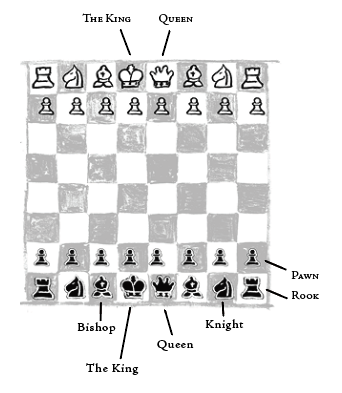
I only know enough about Chess to critique it, but not because it requires critique, but because the way people talk about Chess requires critique. People seem to believe the chessboard is the only nature of the world, the only possible configuration of the world.
Chess is a two-player war game where both sides begin with the same military formation and resources. In Chess, each side shares the same competing goal: to capture the other side’s King. The loss of the King entails the loss of the game. With stakes that straightforward, everyone on the chessboard is expected to perish on behalf of the King if needed, including the Queen, the Piece with the most capacity, even more capacity than the King.
The capacity of each Piece is measured by its mobility. The Queen possesses the most mobility, able to move any number of squares vertically, horizontally, or diagonally both backwards and forwards, combining the powers of the Bishop, which can move diagonally back and forth, and the Rook, which can move vertically and horizontally back and forth. The Queen does not possess the power of the Knight, the only Piece that can jump. The King can move in any direction but only one square at a time and also cannot jump.
They say the Queen herself is a new Piece on the board. In this more than 1400-year-old game from the lands called India and Persia, the Queen is said to have appeared on European chessboards only 500 years ago, replacing the King’s adviser, the Wazir, with a piece inspired by Queen Isabella of Castile.[1] They say the chessboard hasn’t changed since then.
About how change takes place, in Guerilla Warfare Che Guevara wrote:
It is not necessary to wait until all conditions for making revolution exist; the insurrection can create them.
Guerrilla warfare is a strategy for how a smaller force from below can beat a conventional army from above. The heroes in Guerrilla Chess would be the Pawns, the least powerful, the anonymous front lines, the ones sent out first to fight and first to die, the disposable ones, the least valuable, the ones not even referred to as Pieces only as Pawns. The Pawns can move only one square, two squares if it’s their first move, and only forwards. The Pawns cannot retreat, and Pawns cannot jump. They capture only on the diagonal, one square at a time.
𝋤
I once designed a graduate seminar called “Space and Capital” where I assigned something I’d been wanting to read: writings on war by Gilles Deleuze and Felix Guattari, anarchist philosophers from France who I don’t know if they called themselves that.
In A Thousand Plateaus (1980), in the chapter “Nomadology: The War Machine” Deleuze and Guattari compare Chess, a tactics game, with a strategy game from China called Go, a game older than Chess and even as old as The Art of War.
In Go, the goal is not to capture the King but to capture territory. In Go there is no King. All pieces in Go have the same powers and anonymous identities, reminiscent of the Pawns. Identity, value, and rank does not exist in Go the way it does in Chess. As Deleuze and Guattari put it,
Chess is a game of State, or of the court: the emperor of China played it. Chess pieces are coded; they have an internal nature and intrinsic properties from which their movements, situations, and confrontations derive. They have qualities; a knight remains a knight, a pawn a pawn, a bishop a bishop…
Go pieces, in contrast, are pellets, disks, simple arithmetic units, and have only an anonymous, collective, or third-person function. “It” makes a move. “It” could be a man, a woman, a louse, an elephant. Go pieces are elements of a nonsubjectified machine assemblage with no intrinsic properties, only situational ones. Thus the relations are very different in the two cases.
Before Deleuze and Guattari, I had never heard of Go. For the rest of the semester, I asked around if anyone knew how to play, but almost nobody had heard of Go. One day I asked my neighbor across the hall who I hadn’t known before, sharing about Deleuze and Guattari and the war machine. He said he didn’t know about Go, but that one of our neighbors in the same building was a Chess teacher, and he might know.
The Chess teacher turned out to be the 1988 Under-10 World Youth Chess Champion who had beat Bobby Fischer three times, he said, and he had never heard of Go. He spoke Spanish more than he spoke English and had been born and raised in the Maya world. His father was a refugee from Haifa and his mother was from Bethlehem.
I asked if he had visited. He said no. I sensed he wasn’t used to talking about Palestine, so I didn’t ask that much anymore. Much later he would share that, long ago, he had wanted to compete under the Palestinian flag in World Chess but had been forbidden by forces both from above and from below.
He looked up Go and became curious about it, too. We couldn’t find anyone with a board, so we played on a tablet and let the computer inform us when we did something wrong. I can’t remember if he beat me every time. We stopped playing the day I made a single move that made the computer flash the board several times. It announced I had just won, and the game was over. We could only stare at the board. Maybe it was what Deleuze and Guattari had written about:
All by itself a Go piece can destroy an entire constellation synchronically; a chess piece cannot…
𝋥
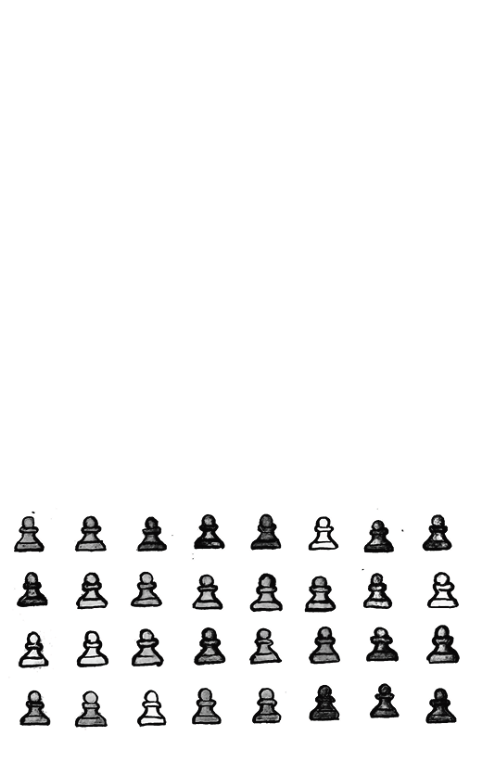
Sometime later, I came across an illustration from a series La Vida en el Ajedrez, Life in Chess. It showed four rows of Pawns against one row of Pieces with no Pawns protecting any of the Pieces. The artist, Eduardo Salles, had entitled the illustration Revolución, Revolution. I wondered the backstory: how had the Pawns recruited more Pawns to become 32? Had the other side’s Pawns been convinced to switch sides?
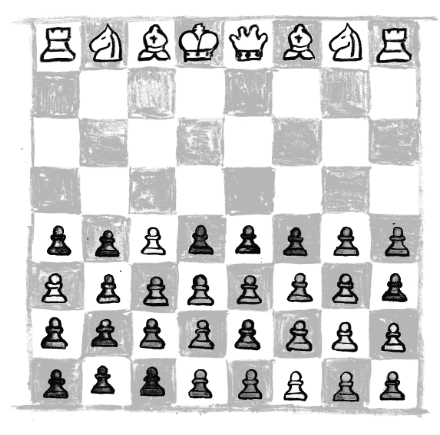
I played the artist rendering in real life using only legal moves and found it was true: 32 Pawns on a chessboard can overpower the Pieces and capture the King. Not by changing the power of the Pawns, but by changing their relationship to the Pieces. And by changing their relationship to each other.
In order to shake off the oppressor, the Pawns must stay close together, keeping each other safe while moving forward, knowing some be martyred. Still, while the odds of winning are good, winning is not a guarantee. The sides must be kept closed off so a Piece like the Queen can’t take them out from behind.
𝋦
The other day, I called my old neighbor to get his assessment on whether the 32 Pawns can win. His answer was that my chessboards were sideways. They’re fixed now. I thought he might remark on why my Pawns were all different instead of the same, but he didn’t. I thought he might be insulted I had changed the sacred chessboard. He wasn’t. He later showed me online drills he gives his students that change the board all the time, including a well-known Chess formation with 36 Pawns instead of 32. It’s called Horde.
Since white always makes the first move in Chess, I asked him if it will make a difference that the Pieces are white instead of black, and that the Pawns are black instead of white. He ignored my question and shared a story of a student who asked him if it was racist that white always goes first in Chess. He said he could only laugh not knowing what to say. I said I wouldn’t be surprised with Isabella up there as Queen.
After inspecting the rest of the board, he confirmed the 32 Pawns can overcome the Pieces and take the King. As long as they stay close together and keep the sides closed off from the Queen. To statistically confirm, he showed me how to log onto lichess.org, an open-source Chess platform he uses with his students, and I noticed that next to his username was an icon of a globe and a Palestinian flag.
𝋧
They say the chessboard hasn’t changed in 500 years. If it’s true it’s not necessary to wait for the conditions to change, as Che Guevara taught, that the insurrection can create the conditions, then what if the Pawns change the chessboard’s conditions? What if the least powerful, the anonymous front lines, the ones sent out first to fight and first to die, the disposable ones, the least valuable ones changed the conditions?
What if the ones below could change the landscape of battle by changing their relationship to the above, by changing their relationship to each other?
This has been excerpt of Palestine 1492: A Report Back, by Linda Quiquivix
Footnotes
[1] Marilyn Yalom, The Birth of the Chess Queen: A History (Harper Perennial 2005)