Below is an excerpt of Palestine 1492: A Report Back, by Linda Quiquivix
They started out as tents, as any refugee camp might. A temporary space for people fleeing war. But for many who have never seen a Palestinian refugee camp before, it comes as a surprise that the camps are crowded buildings now. The refugees have been in resistance so long to need all this concrete.
But it took a few years for them to agree to the buildings. The first compromise was walls only, no roofs. Roofs imply permanence. But as families have grown and as the camp’s spaces have not, roofs have been added, many roofs, most serving at once as one generation’s ceiling and the next generation’s floor.
But anyway, these buildings are their houses, not their homes. Their homes are inside ‘48, the land on which the State of Israel was created after the Nakba, after the catastrophe.
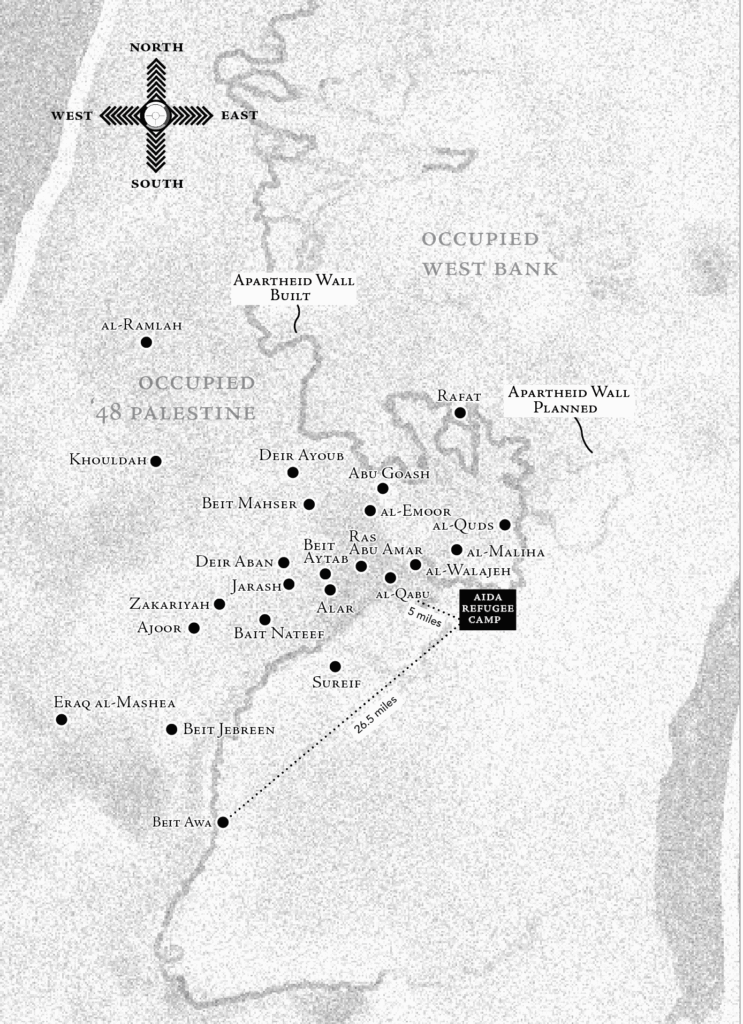
While Israel’s official maps show borders that express it is impossible for the refugees to return, those same maps communicate that home is only walking distance away. In Bethlehem’s Aida Refugee Camp, in the West Bank, I am learning to agree with a common Palestinian refrain: “Here, the map is useless.”
The way the map tells the story, distance is space only, not also time. And not also violence. Checkpoints and borders are mere lines and dots to travelers like me. For Palestinians, those same lines and dots are threats, cruel reminders, traumas of Israel’s deadly force.
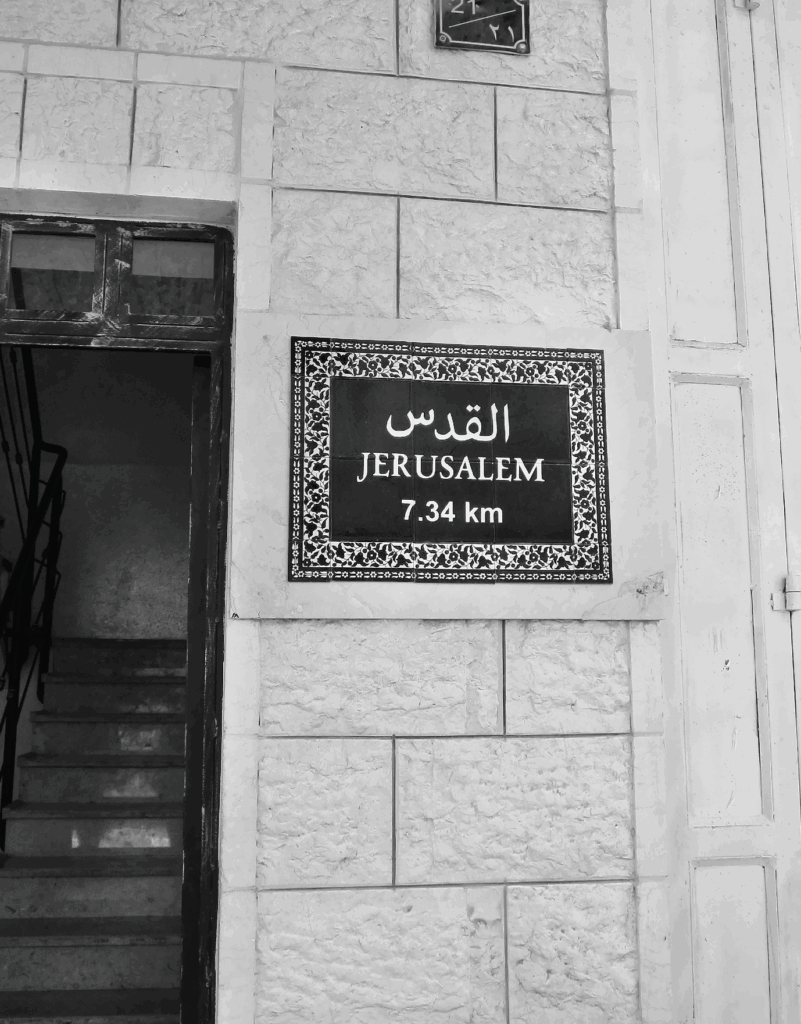
Outside of Lajee Center in Aida Camp exists a ceramic sign that announces al-Quds, Jerusalem, is only 7.34 kilometers away, a distance less than 5 miles. The sign is correct if we assume smooth space: no checkpoints, no walls, no borders, no violence. Nidal remembers when he and his friends could walk from Aida Camp to al-Quds in the evenings to eat ka‘ak, a sesame-covered ring-shaped bread, and could walk back to the Camp still in time for bed.
That was before Israel closed off the Holy City to most Palestinians years ago. Before the Second Intifada in September 2000. Before Israel’s Siege on the Nativity Church in April 2002. Before Israel’s Apartheid Wall was officially announced after the Siege that June. Now, al-Quds is too far, a distance impossible for most Palestinians. Most do not qualify for Israel’s special privileges called entry permits. It is what the ceramic signs like these, about 80 throughout the West Bank, provide reminders of in claiming the distance to al-Quds: here, the map is useless.
Nidal is a refugee from al-Qabu, five miles away from Aida Camp, and his wife Amahl is a Palestinian Citizen of Israel from the Galilee in the north, close to Lebanon. Israel is the only one who can grant Nidal a special permit to cross into ’48 to visit Amahl’s family.
Amahl and Nidal share out loud a mental map of what the permit maze has looked like thus far. It has included various visits to different offices over several weeks, each of their movements taking them farther and farther in the opposite direction. Nidal would be denied.
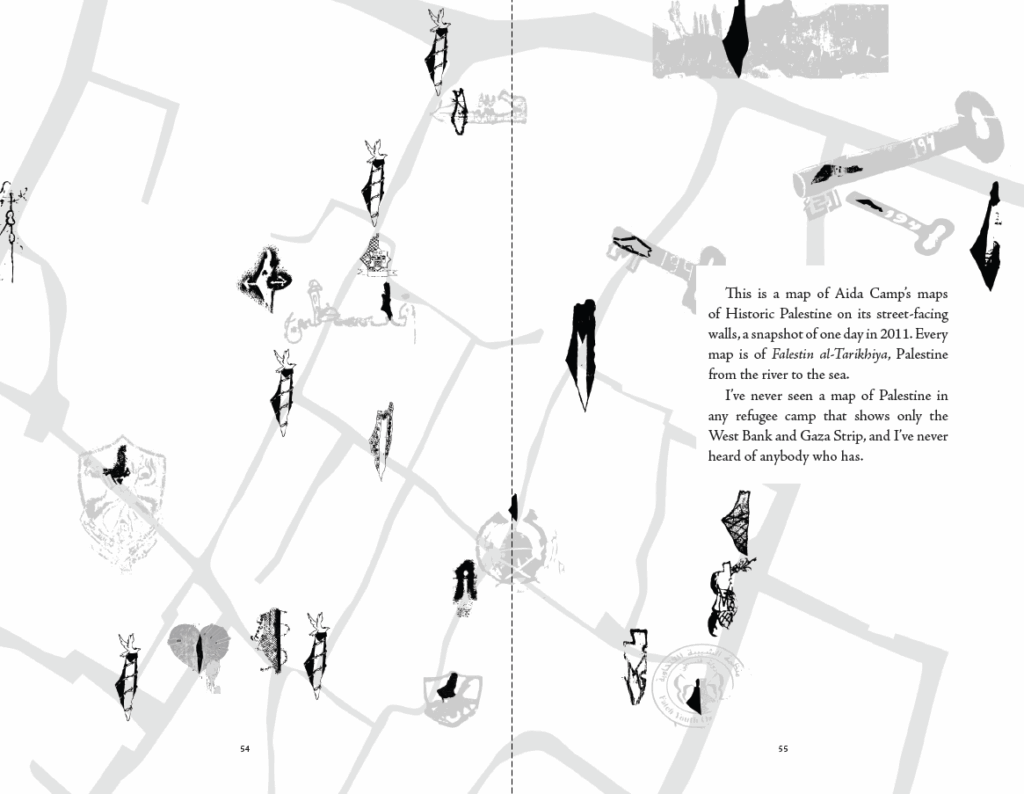
Still, it is from the refugees themselves that I learn the map is not always so useless. Every day, walking past the maps of Palestine on murals and graffiti all over the Camp, letting the world know in English WE WILL RETURN, and like that in all capital letters, I learn to agree. They are all maps of Historic Palestine, of Falestin al-Tarikhiya before 1948, before the United Nations’ partition, before the Peel Commission, before the British cut up Palestine into smaller pieces of private property to sell on the market, to speculate on the market, to displace Palestinians, today refugees, they say the oldest refugees, or at least among the oldest refugees who still know they’re refugees.
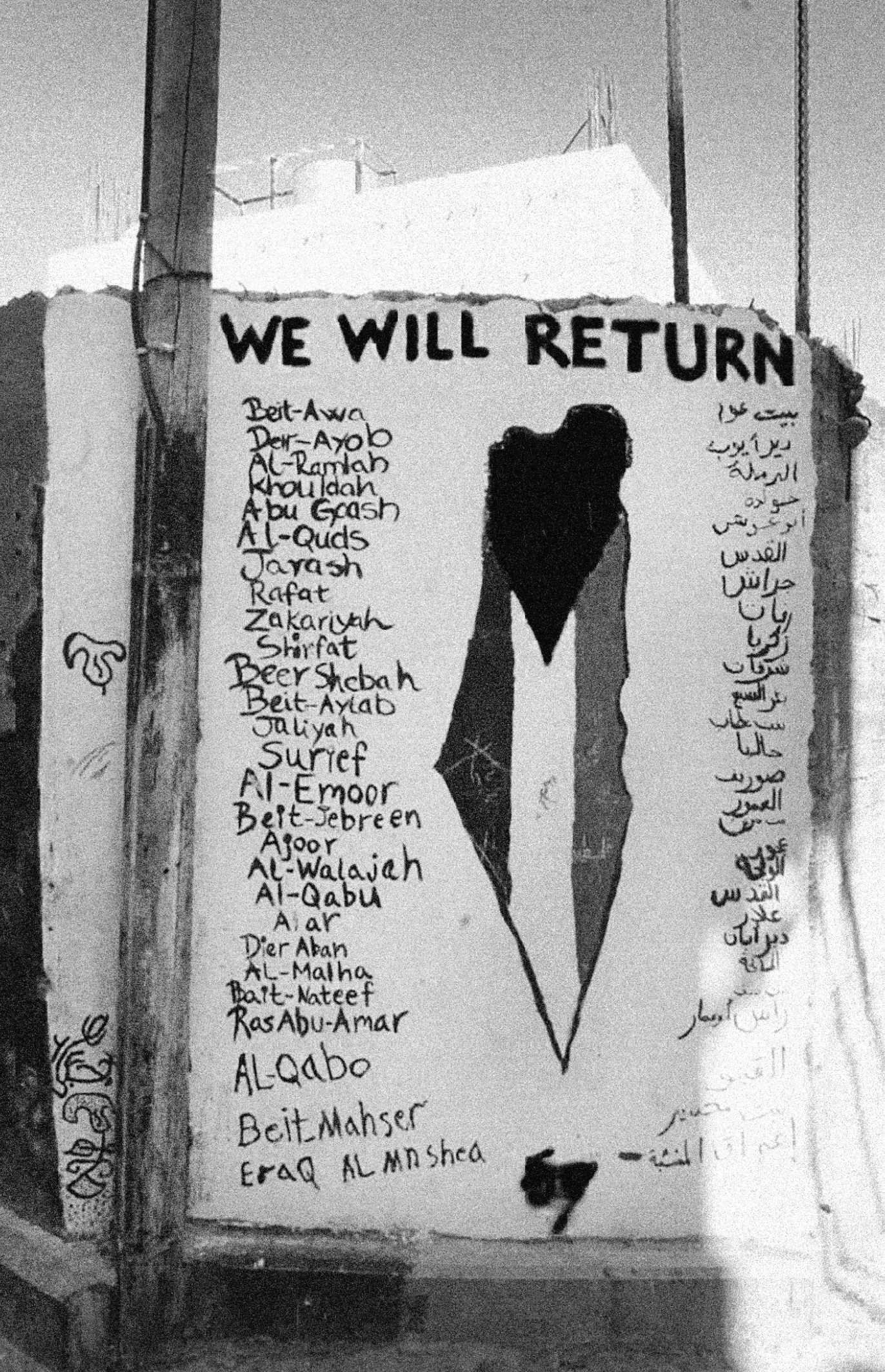
The refugees’ maps insist on all of Palestine, from the River Jordan at its eastern border to the Mediterranean Sea at its western border. And while the refugees’ maps have no authority on the ground, they are still terrifying for the Zionist project. It means the refugees are still refusing their own erasure, refusing their own displacement generations later. It means that maybe it’s true what the refugees promise: WE WILL RETURN, in all capital letters just like that.
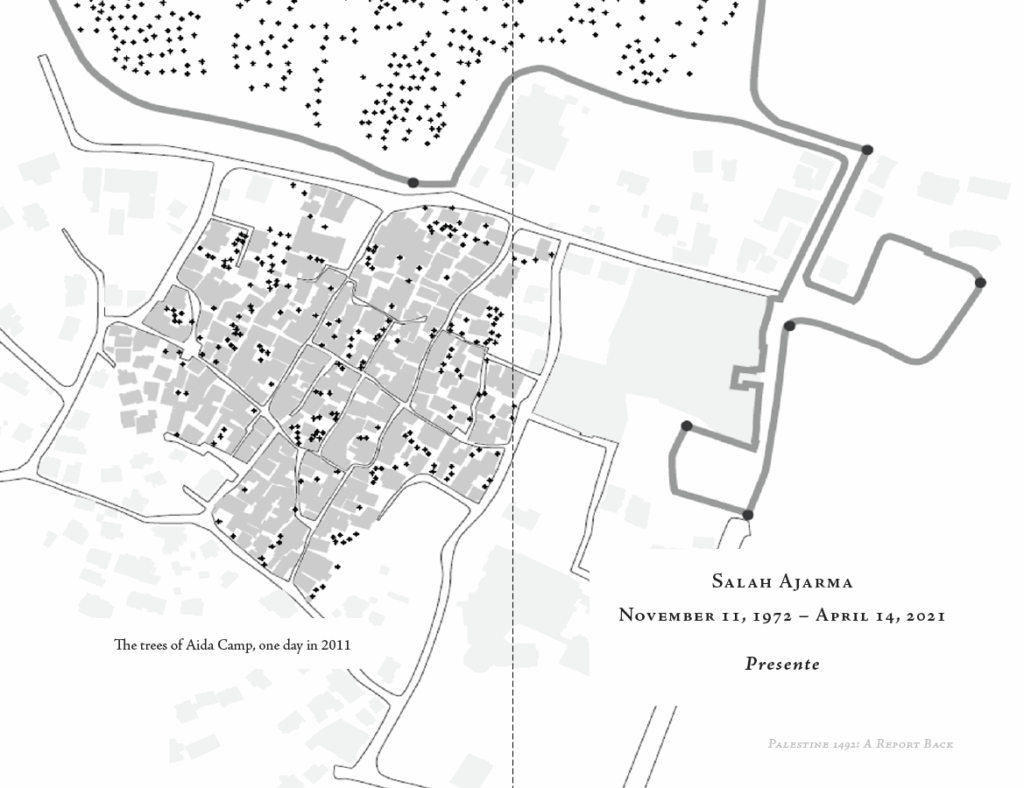
This is how I can learn to agree with my Palestinian elders: the map is not always so useless.This is a map of Aida Camp’s maps of Historic Palestine on its street-facing walls, a snapshot of one day in 2011. Every map is of Falestin al-Tarikhiya, Palestine from the river to the sea.
I’ve never seen a map of Palestine in any refugee camp that shows only the West Bank and Gaza Strip, and I’ve never heard of anybody who has.
Salah Ajarma, the Director of Lajee Center, learned I was a geographer and asked right away if I could map the camp. I agreed after much hesitation out loud. “What if Israel gets the maps?”
“They already have the maps,” Salah replied. “When they arrest us, they even show us the names of our families on the buildings.”
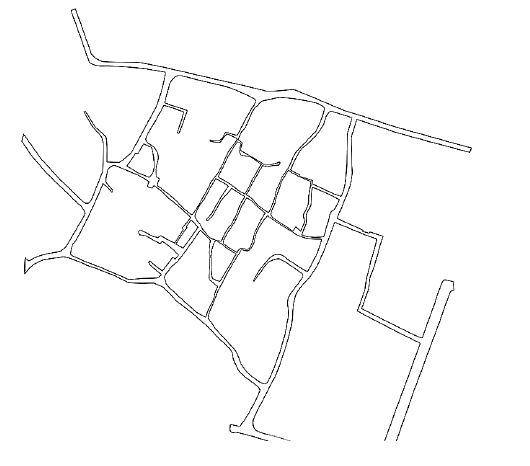
Some weeks later, we were able to locate a high-resolution aerial photograph of Aida taken by the Israeli military. They’re the only ones allowed to photograph from the air. The photo was shared with us by a Palestinian geographer. I traced it with a Geographic Information System (GIS), and when the final draft was complete, Nidal assigned a young man and a young woman from Aida Camp to walk the camp with me to check my work.
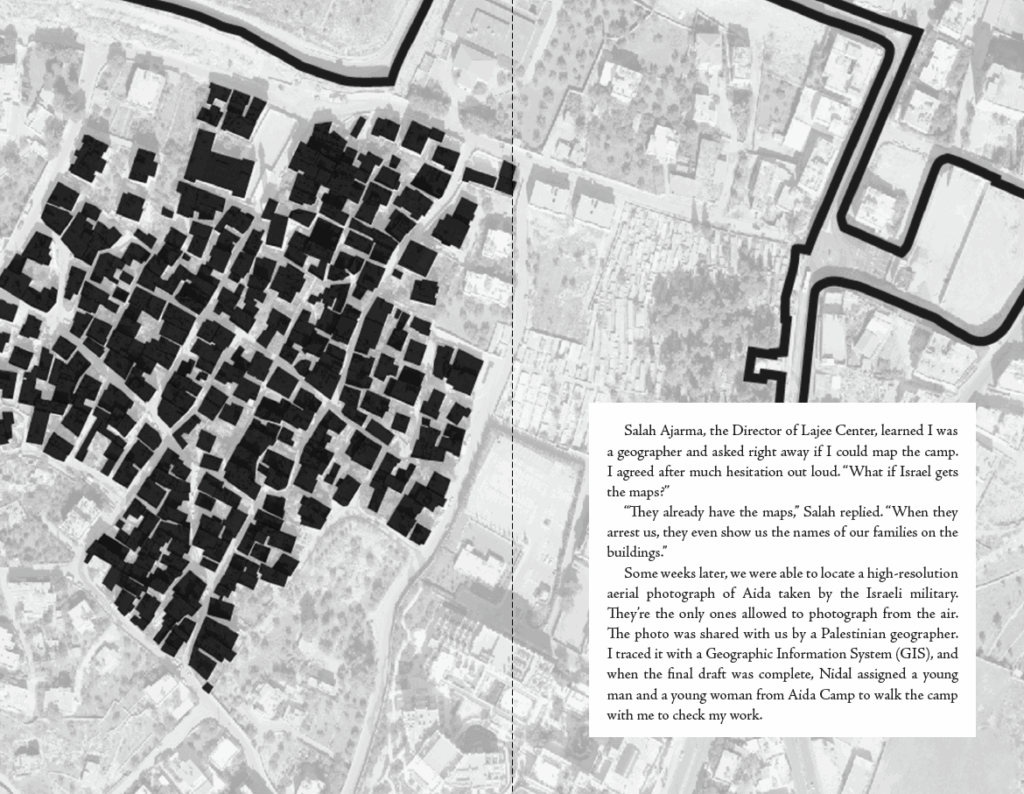
When I asked Nidal if I had accurately traced the streets on the map as shown above, he nodded but remarked, “You know, the rooftops are also streets.” He dotted a road network on the roofs as he had maneuvered them while under curfew during the Second Intifada. Nidal’s is the map on the next page. Jumping from roof to roof was how he and his friends could check in on everyone and pass medicine, food, news, and supplies.
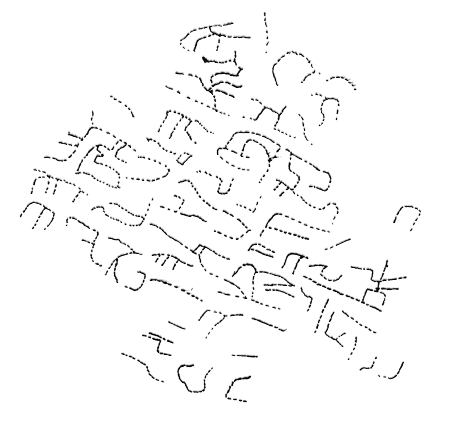
I soon learned that every Palestinian seemed to have a story like this, especially in times of shaking off the oppressor, especially in times of intifadas, with every geography different for everyone yet still the story of everyone, each with their own calendars, each with their own ways, each new path out of necessity, each new path impossible to map by anyone else, least by a professional geographer like me.
Israel’s predatory geography brings about this necessity. The State of Israel has never defined its borders. The State of Israel is still expanding. For Israel, its border with Palestine is not a line on the map but a life/death confrontation on the ground in everyday life. Israel’s border with Palestine is the violence necessary to defend the State, its so-called “iron wall,” the apartheid line between the Human/Non-Human legitimized by the United Nations and its institutions, legitimized and created everyday by international law. If this is true, then the problem is bigger than Palestine, bigger than Israel, bigger than Europe, bigger than the United States or the geography called The West and the other geography called The East. Palestine is a problem of the world, the world is the problem of Palestine. What if it’s true what they say, that changing the world is difficult, even impossible, and so a new world must be built, a world where all the worlds fit. And what if it’s true that resistance comes out of necessity and love, not out of romance.
Palestine’s other geographies in the Camp are built and maintained under conditions of death, meaning they are built and maintained under conditions of necessity, out of a love for life in the face of death, a journey possible generations after the Nakba through collectively lived struggle and a social fabric of trust.
Placing my map of Aida Camp’s streets next to Nidal’s map of Aida Camp’s other streets, I was reminded of Amílcar Cabral’s appeal to the ones who make their lives at the cost of others. Either they betray the struggle of the below by preserving their privileges, or they can identify directly with the below and commit “suicide” as a class, by going below rather than above, by going below with the below so that the intifadas of the exterminated and displaced becomes an equally shared necessity.
Geographer suicide? Professional geographer suicide. The map is not always so useless.
I wonder what it will it look like, what it will feel like, this self-annihilation of the professional class, of the ruling class or of the ruling class in-the-making, of the expert class. What might it look like, what might it feel like instead to become somebody else, somebody who insists, like the Palestinians do, that it doesn’t have to be this way, with both humility and dignified rage.
What might it look like, what might it feel like to walk with the below, to place yourself under fire with the below so that the need to shake off fascism becomes a shared necessity for you, too?
I do not know, but I hope we will find out together because there’s no blueprint. From the Zapatistas I learn to ask questions as we walk, caminando preguntando. From Aida Camp I learn sometimes we must ask questions as we jump.
May we learn the answers together.
This has been an excerpt of Palestine 1492: A Report Back, by Linda Quiquivix