This is an excerpt of Palestine 1492: A Report Back, by Linda Quiquivix
Christopher Columbus had been convinced the End of the World would arrive in exactly 155 years.[1] By the “End of the World” Columbus meant the return of Jesus to Earth, and he didn’t mean it metaphorically. He also didn’t mean Jesus would return just anywhere, he meant specifically to Jerusalem.
According to his El Libro de las Profecías, his Book of Prophecies (1502–1504), in order for Jesus to return to Jerusalem, certain events must first be enacted. These included imposing Christianity throughout the world and launching a final Crusade against Islam to reconquer Jerusalem.
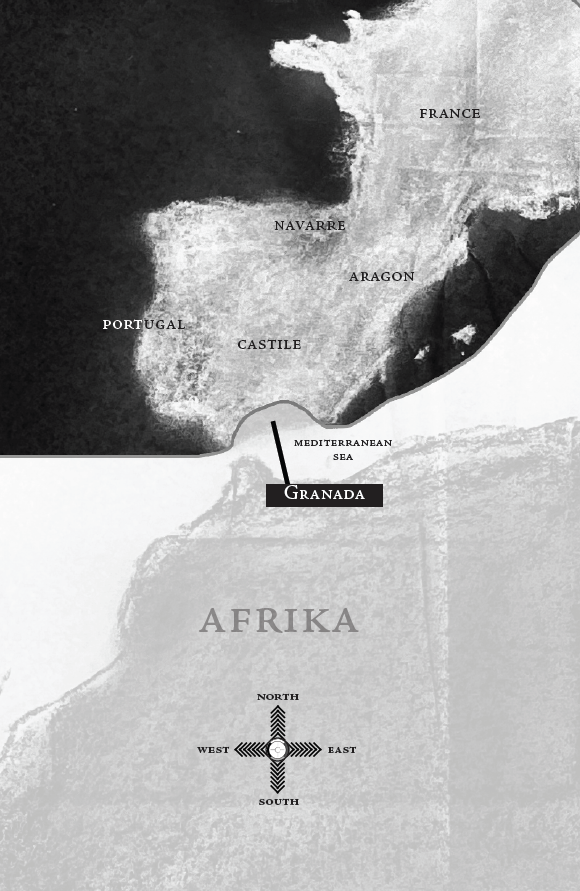
Columbus’ genocidal imposition of his world in Abya Yala was far more religious than it is today given credit. Settler-colonial genocides are far more religious than they are today given credit.[2] Before Columbus declared his Holy War in Abya Yala on October 12, 1492, he had already taken part in a Holy War some months before. Columbus had been in Granada on January 2, 1492 witnessing the Black Afrikan Muslims surrender their last palace on the Iberian Peninsula to the Catholic Monarchs, imposing Christianity as universal throughout the Peninsula, and solidifying the Mediterranean Sea as Europe’s border with Afrika.
Columbus the Crusader had known the Earth is round. After the taking of Granada from the Muslims, he was convinced he could reach the east by sailing west to help take from the Muslims Jerusalem next.
Throughout Columbus’ lifetime and for many centuries before, the Roman Empire had been re-establishing itself in the West by a Crusade against Islam of another name, the Reconquista, Rome’s Reconquering of the Iberian Peninsula from the Black Afrikan Muslims sometimes called the Moors. It had taken the Catholics centuries to “reconquer” the whole Peninsula by 1492. Granada had been the final battle won by Queen Isabella of Castile and her husband, King Ferdinand of Aragon. On January 2nd, when Isabella’s forces accepted the surrender of the palace in Granada, many historians say Modern Europe could be born.
That’s another way to say that Modern Europe was birthed by the blood of Black Afrikans, Muslims, Jews, and anybody different, anyone the empire considered the Devil. The Catholic Queen decreed right away that Jews could remain on the Peninsula but would have to convert to Christianity or leave. Jews could assimilate or go. Back when there were still places to go.
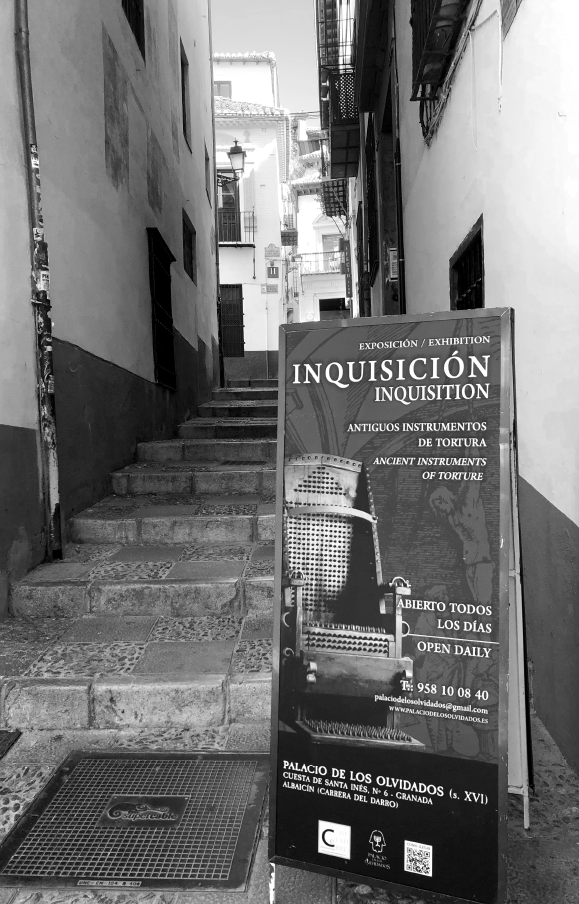
Today in Granada, on the other side of the street where tourists wait to enter the infamous palace, a very other palace beckons, el Palacio de los Olvidados, the Palace of the Forgotten. A sign points to one of its permanent exhibitions: the Spanish Inquisition Museum of Torture, where exhibited are the various torture instruments Isabella used on Jews suspected of lying about their conversion to her world.
Conquest, assimilation, torture, extermination. Holy War was already under way within Europe before it was declared on Abya Yala by Columbus and Them. Columbus called the weapons of the Taíno people alfanjes, a Spanish word derived from Arabic for a curved metal scimitar inscribed with Quranic verses, commonly used by Muslim soldiers in battle. Hernán Cortés who followed Columbus wrote that the Mexica women looked “Moorish” and claimed to see more than 400 mosques in Anahuac, referring to the emperor as a “sultan.”[3]
Everywhere Columbus and Them looked in Abya Yala, there was Islam, there was a Muslim, there was the Devil according to the Empire. This was Abya Yala’s great misfortune: that Columbus was a Crusader.
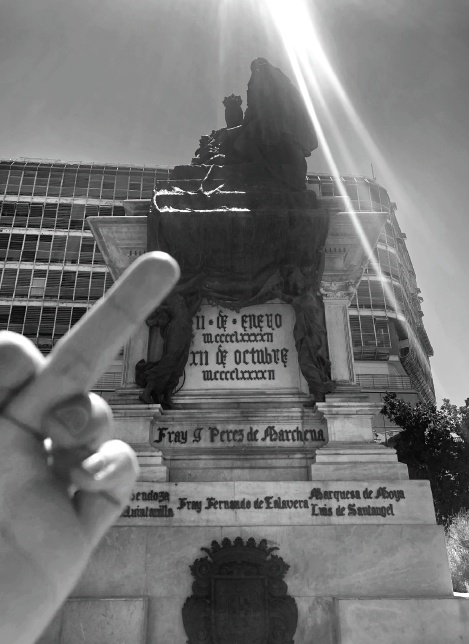
Today, in the middle of a busy intersection in Granada, three banks and a department store guard a statue called the Monument to Isabella the Catholic and Columbus. The two of them are up there making a deal. Their statue’s foundation has two dates:
January 2, 1492
October 12, 1492
Down the street from their statue, there exists a big church you can tell was built to make you feel small. Not like you should be quiet, but like you should shut up. I hate it. I tell it I hate it. I don’t even know what it is yet. The next morning I learn it’s called the Royal Chapel of Granada. I learn it’s there where the corpses of Isabella and Ferdinand have been rotting for only 500 years.
This is an excerpt of Palestine 1492: A Report Back, by Linda Quiquivix
Footnotes
[1] Pauline Moffitt Watts, “Prophecy and Discovery: On the Spiritual Origins of Christopher Columbus’s ‘Enterprise of the Indies’,” The American Historical Review, 90(1), 73
[2] For an important corrective, see Steven Salaita, Holy Land in Transit: Colonialism and the Quest for Canaan (Syracuse University Press, 2006)
[3] Alan Mikhail, God’s Shadow: Sultan Selim, His Ottoman Empire, and the Making of the Modern World (Liveright, 2020)